Friedlob and Lang's Tabloid Thrillers --- Part Two

While The City Sleeps got no chance to build momentum, let alone gain sleeper status, which under better distribution circumstance, might have come. Key openings were spread way apart --- New York in May (1956), Los Angeles in August, and finally Chicago in September. RKO saturated mass circulation magazines from May 24 in LIFE to July 8 in Movie Time, but what good were full-page ads with playdates so delayed as Los Angeles and Chicago? Was there showman resistance to booking While The City Sleeps? Here may have been another of those shows to suffer for theatres no longer being affiliated with production/distribution, as picking and choosing exhibs weren't rushing to play While The City Sleeps.


Gotham's two-week stand followed seven weeks of The Conqueror at the Criterion, receipts for While The City Sleeps called "fair" by Variety. At $16,000 for its opening frame, Friedlob and Lang's thriller at least beat up-the-street The Killing's initial week by $4,000, which illustrates how pics we now celebrate barely eked out house nuts on first-run, even in largest bergs where you'd figure savvy viewers were aplenty to support them. Pittsburgh's Stanley Theatre also had While The City Sleeps in May among a "string of clucks," that jinx broken by arrival of The Man Who Knew Too Much and $18,000 for its first week. Just preceding While The City Sleeps took a measly $8,000, especially punk for a 3,800 seat venue, and was gratefully swept out with "recent duds" to make way for Hitchcock's Paramount hit.


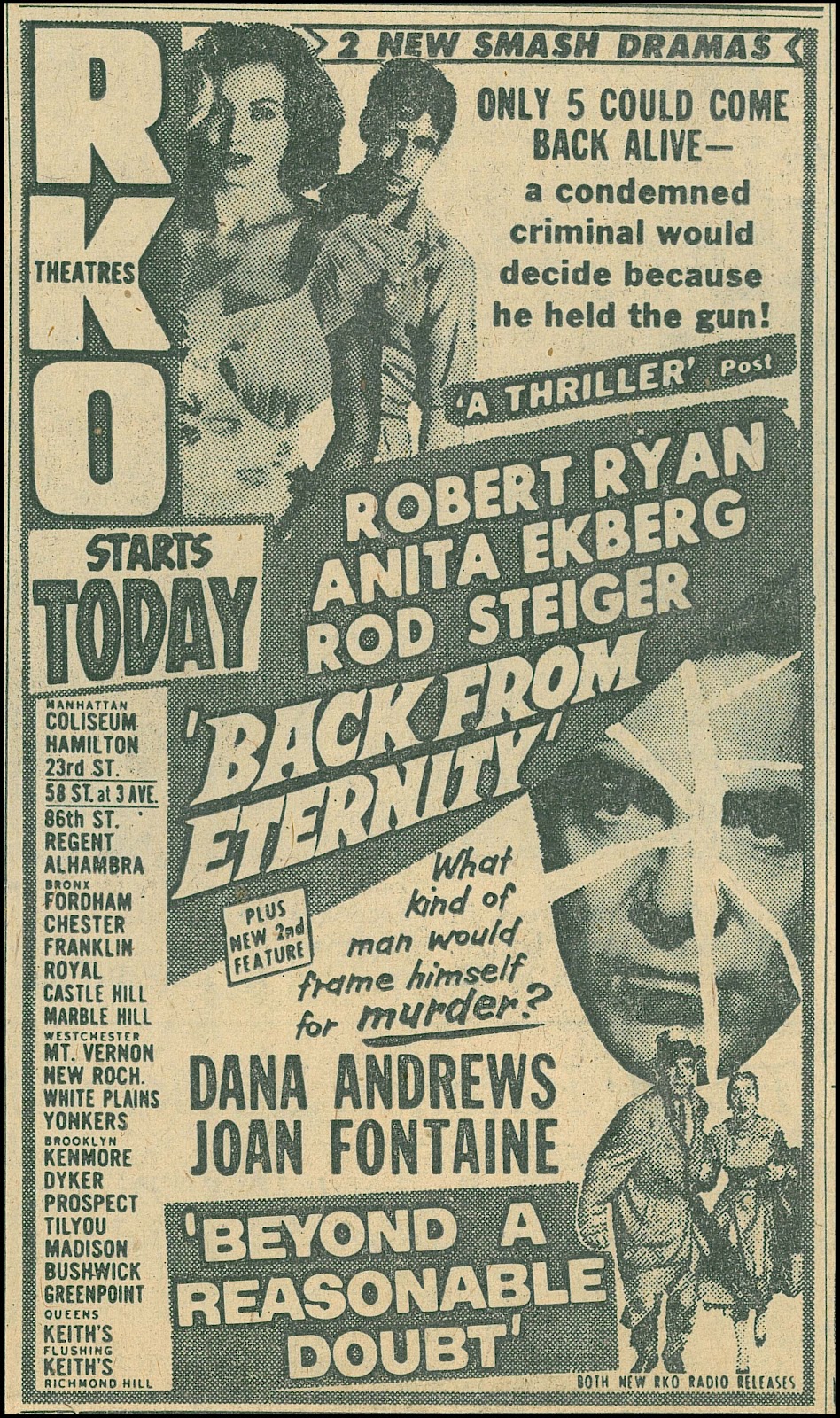
LA saw "dull" receipts for While The City Sleeps upon August arrival and two weeks play with RKO-reissued Flying Leathernecks. Whatever interest magazine ads generated may well have dissipated by this late booking. Certainly that was true of Chicago and September's late arrival of While The City Sleeps. In fact, it played as a second feature to Republic's Lisbon, starring Ray Milland, the tandem earning a "fair" $26,000 at the massive Chicago Theatre (3,900 seats). Beyond A Reasonable Doubt had by this time opened in New York at Loew's State, where it performed "below hopes" with $13,500 on a first week. A second would be cut short to bring in MGM's The Power and The Prize. Reasonable Doubt was sold as a thriller with a "trick" ending. Maybe it wasn't tricky enough. Reviews would not be so generous as for While The City Sleeps. LA saw Reasonable Doubt with another RKO retread, The Big Sky, two weeks again the limit with lackluster turnout.


Maybe the trouble for both While The City Sleeps and Beyond A Reasonable Doubt was a distributor on last legs and patronage done with commonplace product. Movies by 1956 had to be special to pull customers away from television. Youth might support hot rod and monster fests, but adults, to whom Friedlob and Lang aspired, wouldn't pay babysitting and car park fees to watch stuff barely distinguishable from freebies at home. While The City Sleeps had a good concept, maybe even ahead of its time, but all the cast, save Dana Andrews, had done TV --- Ida Lupino was more associated with that medium than with movies by Spring '56 when Sleeps sought admissions to watch her emote. Failure to sync up expensive national advertising with key playdates for the film were ruinous as well, but this was symptomatic of an industry having lost that essential wheel of theatres owned by and standing ready to play off merchandise when and where distribs dictated. A show like While The City Sleeps had to do without smooth machinery that would have pushed it through ten years earlier, but was too broken down now to be of much help.


A Limping RKO Tenders It's Product for 1956's Autumn Season


RKO Hoped The Stripper Lure Would Cinch
Patrons for Beyond A Reasonable Doubt
 Sex, or the promise of it, even if an empty one, was still a bedrock to selling. Both Sleeps and Doubt had hooks exploitable --- the former and lipstick killings, the latter with strip-tease backdrop to much of its narrative. Knowing patrons saw ads for the tease they were. Whatever impurities were promised, there was still a Production Code to scrub clean releases via US companies. This was how foreign pix, not subject to the Code, made inroads after the war. Beyond A Reasonable Doubt based much of a campaign on its "Hush-Hush" ending, a device used before (1950's In A Lonely Place had been billed as The Bogart Suspense Picture With The Surprise Finish). Risk for Reasonable Doubt was letting down patrons with a fade they did see coming. As it seems not to have taken off ticket-wise, we can assume the ending didn't surprise, or that customers couldn't be bothered one way or the other.


Beyond A Reasonable Doubt Goes New York's
Second-Run Saturation Route as a Support Feature
Beyond A Reasonable Doubt posits Dana Andrews as a man who frames himself for an unsolved murder in order to show how anyone can be sentenced wrongly to death, therefore making the case against capital punishment. There was reluctance to go the distance, however, with regard politics such a theme invited. The film's writer, Douglas Morrow, gave assurance that Doubt's story "does not take sides." His twist ending neatly got 'round thornier issues by putting Doubt square in melodrama/exploitation's column. While The City Sleeps and Beyond A Reasonable Doubt were for years available only in full-frame edition. Warner Archives now offers both in wide screen, in Sleeps' case, a little  too wide, as SuperScope's 2.1 ratio tightens the (likely) designed for 1.85 frame too snugly. Doubt's a more comfortable fit, being spared SuperScope retro-fit, and neatly cut to 1.85 measurement. Wider presentation enables the two to entertain better than was the case over a past fifty-five years. With interest in Fritz Lang on continual rise, these should be welcome arrivals on DVD.


Friedlob and Lang's Tabloid Thrillers --- Part One

Friedlob (Bert's) placement over Fritz Lang is no typo. Hustling dollars in the mid-fifties to independently produce features was a tougher job than directing them. Friedlob managed While The City Sleeps and Beyond A Reasonable Doubt, Fritz's final US pair, died prematurely (8/56), then bore Lang's epitaph (Son of a Bitch) from there --- one more (now less) obstacle between an auteur and his art. That neither film would have been made without Friedlob's push, let alone with Lang directing, is today forgot. Like most giddyup guys who enabled great directors, he ranks beneath a footnote. Someday there ought to be a book about the lone wolf pack who did movies from ground up and put them before a Golden Age public. To know of Bert Friedlob and his fraternity is to shovel frozen ground, yet I increasingly find him of equal (greater?) interest than further accounting of Herr Lang beset by another producing bogeyman.


Friedlob introduced roller derbies and midget races to South Pacific isles during (comparative) youth, then fitted skates to Mickey Rooney for The Fireball, an indie partnership with vet director Tay Garnett that 20th Fox thought enough of to distribute. Bert grazed star-lit clubground where flashbulb-baits Lana Turner, Eleanor Parker (a wife), numerous others gathered, that in addition to having once wed money. He'd wade into bar fights on behalf of pals outnumbered. Columnist Jimmy Starr wrote of shorts and robe-clad Friedlob bully-clearing Mocambo's floor as afterthought to buying a newspaper outside. Jimmy was in a jam and battle-ready Bert saw not the need for formal dress to join the dust-up. Needless to add, he made valued friends and used them to churn budget shows. The Steel Trap was his nifty vault heist thriller also Fox-handled, as was Bette Davis as The Star, her confidence in Friedlob a vote of same throughout the industry.


Making good with these got BF a 20th berth to produce Untamed for the company (1955, with much budget and location), meaning his ship had come in, but Friedlob preferred smaller pics done his way, thus While The City Sleeps, and welcome work for lately idle Fritz Lang. Begun as News Is Made At Night in Spring '55, Friedlob had the $ and commitment to release from United Artists, but sold interests, plus the negative, to product-starved RKO in early '56. Part of his compensation would be a term contract and that studio's bankrolling follow-up Beyond A Reasonable Doubt. There was meantime a title switch from News Is Made ... to While The City Sleeps, along with "conversion" of the neg to SuperScope, an ill-fit, as such wide projection was never contemplated when Friedlob and Lang did Sleeps a year earlier.


Friedlob had gotten trade ink via his campaign against vicious comic books, this being outgrowth of a personal crusade against such pulp publications launched by director Lang. The latter had read Seduction Of The Innocent by Dr. Frederick Wertham and was "engaged in battle" since. Lang suggested insertion of the attack on the horror comics to underline the character of the psychotic killer in his film, according to Variety's Hollywood Inside column. With much of Hollywood similarly appalled by vile comix, here was easy route to establishment approval for a movie that might otherwise have been ignored for simple exploitation it was, though Casey Robinson aboard as scripter, plus remnant of Lang's prestige, did suggest quality beyond low-cost norms.


"The New RKO" was for mending ties with a show-world alienated by the company's disposal of its library, a first such mass migration to rival television. The company promised nine new features completed by September 1956 and fifteen by the end of that year. Foreign producers were wooed to bring another two or three to RKO's release plate, these financed by the waning major. Top talent was scared off by instability that had become another name for RKO, so product reflected lower standards --- The First Traveling Saleslady, Tension At Table Rock, Back From Eternity --- all lacking major star wattage, let alone distinction otherwise. Friedlob and Lang's Beyond A Reasonable Doubt was completed before While The City Sleeps was released in May 1956. Both, said trades, had come in under schedule and budgets, helpful blurbs to secure future work for the team, only by now Lang had fallen out with Friedlob, who would himself die of pancreatic cancer within months.


Selling of While The City Sleeps aimed square at trash sensibilities. Early ads mimicked covers of notorious Confidential magazine, then an industry scourge and regarded near-as-bad as kid-chilling mags Lang deplored. Reviews were overall good. This was a cheap (and cheap looking) picture, but with a game cast of has-beens and character folk, well-schooled at bottom scraping, fun was assured. "Sensational Lipstick Murder" was the hook ... in fact, a series of them, catnip for skin art/sleazy ads of Rhonda Fleming and Sally Forrest, femmes offered up as potential prey for "Mixed-Up Mama's Boy" killer John Drew Barrymore. Lang dramatizing such serial-antics harked back to his German M, but also forecast 60's and later excess when a whole biz would embrace Psycho and imitator doings.

WB Burning Hills Campaign Inflames Exhibs!

Star-selling jumped to warp speed with television. Whereas radio, newspapers (plus fan mags) mostly got messages out before, now there was quicker-than-ever delivery of fresh faces with over (broadcast) night impact. Natalie Wood heated up among teens not just from Rebel Without A Cause in Autumn 1955 theatres, but for anthology TV that put her before more eyes than attended even hit movies. Then there was weekly Warner Brothers Presents using the actress on behalf of pics she was and wasn't in. The maybe unforeseen result of all this was stardom running ahead of even fast-tracks WB laid, the pace and impact of television far from fully understood whatever one's experience with the new medium.


The Burning Hills was, by definition, a program western done for change ($877K negative cost, among lowest of that WB season). Scant months passed between production and release, but it was time enough for merchandisers to know better how to promote Natalie Wood and co-star Tab Hunter. They were twin hula hoops for an advertising age of much increased sexual awareness. So chaste a vehicle as The Burning Hills gave Warner staff less than nothing to exploit. Teenage innocence was a gone concept, ticket-buying youth least of all desirous of it. Marketers knew they had a flat tire and used misleading ads to pump interest. Who knew a few frisky come-on's, borne of sales necessity, would land The Burning Hills on angry letter pages of The New York Post, Variety, Boxoffice, and Harrison's Reports?


"Downright misrepresentation" was how complaining exhibitors summed up "trashy" ads for The Burning Hills. The audience is long accustomed to having its sex on the outside of the theatre rather than on the inside, but Warners' Cloud-Cuckoo Land of publicists had this time gone too far. Boxoffice heard from the president of Kansas and Missouri's Allied Theatre Owners, who likened Warner policy to "selling horsemeat and calling it first-grade hamburger." Let's stay somewhere within the reasonable bounds of truth, the letter said, If we don't, not only will we drive away the few remaining customers we have, but we will end up having someone like the Better Business Bureaus or Federal Trade Commission analyzing and censoring our ads and then we'll be in some real trouble.


That censorship part was a truest concern, as there had for some time been a Producer's Advertising Code administered by the MPAA to assure that illustrations and text in advertising shall faithfully represent the pictures themselves. Unlike the better enforced Production Code, rules of honest promotion were violated with abandon, and by September of 1956 and release of The Burning Hills, matters were at a head. The Boston Catholic archdiocese decried lurid and suggestive merchandising of pictures that consistently failed to deliver promised goods. The fast buck is once again the obvious motive --- get the people into the theatre, even if you trick them into it. Customers were indeed being played a confidence game that would surely result in patron loss of confidence in studio merchandise.


Said a Resigned Showman at the Time: Perhaps It's OK To Picture a Barebacked Young Man Atop a Young Girl When There's Nothing Like It In The Picture --- After All, Everyone Realizes That This Sort of Thing Wouldn't Be In An American Picture.

The Burning Hills was truly enough hamburger, if not horsemeat. Made to service a teen-fueled market who'd voted Tab Hunter an "Audience Award" via lobby-cast ballots, the western served therapeutic purpose in that year or two wake of James Dean's passing, Tab offered up as heart balm to bereaved youth still in the grip of loss, though newcomer Elvis would better ease their pain with Love Me Tender right around a corner for November '56 release. The Burning Hills played down many a street from Giant, the last of the Deans, and Natalie Wood benefited large from her association with the departed star and their Rebel Without A Cause tandem.


Larger markets played safe by doubling The Burning Hills with Warner westerns past and new, a common thread being veteran names to lure older patronage less than gaga over Tab and Nat. The Chicago Theatre used Seven Men From Now with Randolph Scott to back the teen team and attributed double-billing to a scarcity of top product (it was only a second time the venerable house had gone with a combo bill ... ever). Personal appearing by Hunter and Wood drew $12,000 on the first day, mostly thanks to autograph-seeking kids. Los Angeles got The Burning Hills saturated among hardtops and drive-ins with reissued Dallas, a 1950 Gary Cooper by then evergreen for supporting soft newcomers. Such bills were Driver's Education for green personalities Hunter/Wood, their first co-starring vehicle guided from the back seat by tried-and-true Scott/Cooper.


So now the ad controversy's forgotten and we're in recent receipt of The Burning Hills on DVD from WB Archive. It's in Cinemascope and burnt toast Warnercolor, the first time available wide since '56 playdates. Hills is a comfort western in the best 94-minute sense of the term, flush with reliable support off 50's wanted posters (Ray Teal, Claude Akins, Earl Holliman, Skip Homeier among heavies) and directed without distinction (but who needs it?) by Stuart Heisler. There are fisticuffs rougher than you'd expect Tab Hunter to engage (two exceptional brawls) and he's believable in the saddle. Natalie Wood effects south-of-the-border accenting as effectively as her fans might have in a school pageant, which reduced not the slightest their regard for her. Teen players, idols first and actors second, improved on the job, or didn't. Wood did eventually, as would Tab Hunter in shorter time (Gunman's Walk). Warner Archive has done its customarily fine job with The Burning Hills on DVD. By all means, get it and be closer to the 1956 fan-driven moviegoing experience. Just don't expect these ads to represent any of what you'll see!