The Peter Pan War


Disney films for me represent happy times during an age of innocence. DVD look-backs emphasize joy of attending first-runs where turnstiles hummed and everyone whistled a merry tune. What actually went on behind showman curtains was not so idyllic. A Cold War in news headlines was mirrored by one fought near as ferocious by the industry’s mutually suspicious distribution and exhibition arms. Sometimes their war flashed hot. It seemed a non-stop game of one side trying to do in the other. Government sanctions broke up the trust that enabled film companies to control theatres in addition to producing and delivering movies, but home office powers were since nibbling around edges of the law to get back advantage they enjoyed when business was wide open and unrestricted. Independent showmen as ever took the brunt of policies squeezing them out of money generated by features expected to do well. Peter Pan was such an attraction and came along at a fraying point between opponents spoiling for battle. Distribution’s latest scheme was to pre-release better product for advanced admissions. Never mind that consent decrees entered into by the majors forbade such price fixing. Contracts were slippery and complicated, but end result found theatres forced to bump ticket rates in order to get pictures their customers wanted most to see. The policy had been applied to Quo Vadis, Ivanhoe, The Greatest Show On Earth, and a number of others. Exhibitor groups pointed out that more titles had been sold this way in an eighteen-month period than in ten years going before. Pre-releasing was merely a device for keeping top attractions in larger houses for longer runs and depriving small theatres of opportunity to compete with subsequent playing at lower prices. Favored venues tended to be those affiliated with powerful chains. They had muscle to negotiate terms and guarantee a profit. Regular runs at pet locations would follow pre-release engagements often in those same spots, ignoring clearances independent theatres depended on to differentiate their playing time from pricier first-runs. By the time affiliated powerhouses were done, attractions were not so attractive, as national promotion and drum beating was timed to key dates. Small auditoriums wound up with shows gone stale for their public.


Columbia led off 1953 with arm-twisting on behalf of highly touted Salome. They would pre-release the film only in cities of 75,000 or more, in effect foreclosing eighty percent of theatres across the country. Demands for increased admissions weren’t spelled out in booking contracts, but terms and guarantees made it impossible for showmen to run Salome unless they spiked ticket prices. The Allied Theatres group began drafting a complaint to the Department Of Justice. It was plain to them that film companies were colluding with powerful chains to starve little exhibitors out. By late March, producer Samuel Goldwyn was saying outright that Hans Christian Andersen would run only at advanced admissions, and if the exhibitors don’t like it, they don’t have to play it. Such incautious words aroused trade tempers and embarrassed distributor RKO, handler of both Goldwyn and Walt Disney output. Allied complainants were now looking for evidence of industry wrongdoing they could submit to the DOJ, with hearing dates set for April. A major smoking gun came courtesy the Walt Disney Company when a Cincinnati showmen defied Peter Pan pricing policy for an engagement beginning April 2. Rube Shor was a theatre/drive-in operator (and Allied spokesman) who’d had it up to here with high-handed treatment from distributors and decided to do something very public about it. His drive-in and hardtop ad appeared on the same Cincinnati Times-Star page (shown here) as day-and-date Peter Pan announcements from seven rival theatres. Those venues listed higher prices per expectation of Disney, including fifty cents at all times for children. Shor let kids in free at his Twin Drive-In and emphasized No Increase In Admission on his ad along with a shot at Disney heard round the exhibition world … The management feels since this is not a "Quo Vadis" or "The Greatest Show On Earth," in spite of demands made by distributor, that the families are entitled to this entertainment at "REGULAR PRICES." According to The Independent Film Journal, Shor’s competitors suffered for the comparison, as ticket sales for the seven opposition screens were down. Disney sent Shor a telegram that same day and minced no words. The admission prices that you are advertising in today’s Cincinnati papers fail to meet the conditions of our approval and renders the approval ineffective. Seems Disney had booked Peter Pan with what they referred to as a specific understanding that Rube Shor would charge the same increased prices as other "pre-release" engagements in Cincinnati. But wait, wasn’t this price fixing in violation of the Consent Decrees? We understand that you have already received possession of prints of "Peter Pan" and this is to advise you that no print of Peter Pan" may be exhibited except under a contract approved by us and exhibition without such a contract would constitute a copyright infringement with serious penalties.


Disney reminded Shor of specific ticket prices he was expected to charge. They also sent the telegram to his managers and warned them of personal liability for participating in copyright violation. Shor’s reply defended his right to charge whatever admission he saw fit for Peter Pan and that suggestions to the contrary from Disney or RKO amounted to their willful violation of anti-trust laws. In fact, Disney’s wire had implicated RKO in a violation of the Government’s anti-trust decree. Here was ammunition to go before the hearing board in Washington on April 15, with Disney’s telegram Exhibit A for complainants at Allied. Leo Samuels, the Disney sales supervisor who sent the wire, was suddenly backing off. We are not attempting to tell any exhibitor what to charge for "Peter Pan." We don’t care if he lets patrons in free, but we have a right to license the exhibition of our pictures as we see fit and to expect payment on that basis regardless of the theatre’s admission charges. That’s the exhibitor’s prerogative, not ours. Samuels added that he knew nothing about reports that RKO was asking exhibitors to put their admission prices in writing before contracts were signed. That got RKO skittish and assistant sales manager Walter Branson declared: We can’t make any statement. It’s all up to Disney. Meanwhile, Peter Pan was going into second runs at the same increased prices. Witnesses before the Senate committee said flat out that divorcement of producing and distributing from exhibition didn’t take, and maybe it was time to further separate producer companies from their distribution arms. Words like conspiracy and collusion were applied to industry distribution practices, with independent theatres helpless to operate for the benefit of small communities. One manager in Netcong, NJ testified that RKO wanted sixty percent of his Peter Pan receipts and even withdrew the booking after it had already been advertised. Walt Disney himself was in New York for a weekend and was asked about the controversy. Walt wondered how exhibitors expected a producer to spend three million on a picture produced especially for children and then not be given a chance to get his costs back. Disney said he’d not been informed of Rube Shor’s refusal to boost prices for Peter Pan, but that the showman might be in trouble if he violated his contract with RKO. In any case, Walt concluded, it was an issue for RKO’s sales department to work out.


A campaign in favor of the public was what some exhibitors called a movement to stop inflated ticket prices and so-called pre-releases. National Alled was telling members not to rely on representations from RKO salesmen and supervisors, since without Disney’s stamp of approval, they had no real authority to confirm deals on Peter Pan. As hearings went into late April, rebuttal of Allied member testimony came from representatives of Loew’s and Universal: Where exhibitors find it possible to get together with their competitors, they either divide our pictures between themselves without consulting us, or they assign our pictures to one of the theatres in the locality in accordance with their ideas. We often find ourselves assigned to a second or third class theatre, which we do not like at all, because it greatly reduces our possibility of earnings, and, we feel, eliminates a free market. RKO was also there to claim that what exhibitors called pre-releases was merely deluxe marketing. As for Rube Shor’s under-12 free policy on Peter Pan, that was nothing more than a showman’s attempt to cash in on increased concession sales by using the film as a loss leader. Admit youngsters gratis and they’d more than make it up at the candy counter. RKO also distanced itself from Disney in saying that the threatening telegram had been sent on the producer’s own initiative without ever consulting us (could this move have entered into Disney’s decision within the year to leave RKO and set up his own distribution arm?). Harrison’s Reports dismissed all of this as mere subterfuge. Companies were fixing prices but carefully keeping such agreements out of written contracts so as to appear within compliance of anti-trust regulations. This sort of don’t ask/don’t tell was hard to regulate when obtuse showmen spilled beans as here when Boise, Idaho’s Pinney Theatre listed Nationally Established Admission Prices For "Peter Pan" in large print. It seemed few took worthwhile lesson from the confrontation. RKO came to Rube Shor later that summer with its terms for Hans Christian Andersen. He would tender thirty-two cents for each adult ticket sold and sixteen cents for every child. That was as good as forcing Shor and other exhibitors to increase their prices in order to pay the amounts specified. Whatever remedies were proposed or instituted gave little relief to showmen down the line. I pulled up the Liberty’s somewhat belated November 1953 run of Peter Pan and prices were inflated there as well, children’s seats being thirty cents when they were ordinarily a dime. This Is The Minimum Price This Program Can Be Shown, said Colonel Forehand in small print. Ironically, the product-split referred to by distributors was common practice between our Liberty and Allen Theatres. In ordinary circumstances, the Allen ran whatever of RKO came to town, except in the case of Peter Pan and Hans Christian Andersen. Both of those played the Liberty, and at increased admissions. I’d assume that Mr. Allen refused RKO’s terms, and Col. Forehand took both by default (the Liberty and Allen were our only hardtops circa 1953).


They Dood It Twice


Do catchphrases catch on anymore? I’m too far off the popular culture beam to have any idea. Sometimes I’ll use antiquated expressions to mostly bemused response. The cleverest of them still work. Others are best left moldering. I Faw Down and Go Boom (explored previously here) is among the latter. Rusty-thatched ribber (yes, someone actually called him that) Red Skelton had trunkfulls. His radio show pitched a plethora against walls hoping some would stick. One that did (and how!) was uttered by Skelton alter ego The Mean Widdle Kid. If I Dood It, I Get a Lickin’ … (he does it) … I Dood It! Get it? Now make for the streets and repeat (often) to passerbys. Will you get a lickin’? Sure nuff. They’ll dood it! I think I need a break from this doodling. Maybe an in-patient one (and Word’s spell check is tripping over my repeated use of Dood … It’s Murder, I Say!). Then-kids must have been plenty obnoxious about the house after listening to Skelton. I’m pretty insufferable here just for having watched I Dood It, then revisiting some of Red's radio programs. How pervasive was this line? Well, the day after Lieutenant Colonel James H. Doolittle raided Tokyo on April 18, 1942, many headlines read Doolittle Dood It. Cartoons, mostly from Warners, pillaged the phrase and near wore it out. Ann and I watched No Time For Love last week and Fred MacMurray borrowed it. Then of course, MGM signed Red and ultimately made a wartime hodgepodge in swingtime called … well, naturally it was called … I Dood It. Warner’s Archive is recently out with that. Those who want an intense 40’s pop culture injection need look no further. And that’s a complement, by the way. I like entertainment so topical as to exclude most everyone nowadays watching, especially when it’s zeroed in on eras I prefer to my own. Just get with the I Dood It program, forget its inanities, and savor the air of those whose days and nights were spent following Hit Parades of the moment, be they radio, bandstands, or song sheets from which this show derived (and vice versa).


I Dood It had story origins in Buster Keaton’s Spite Marriage. The set-up never appealed to me for undercurrents of cruelty running through Buster/Red’s relationship with respective femme partners (Dorothy Sebastian in 1929, Eleanor Powell for 1943). Girl marries boy to spite (hence original title) the (unworthy) man she prefers almost till narrative’s end. Both involve wedding nights unconsummated and lead comics mistreated by unsympathetic leading ladies they’re unaccountably daffy over. Operating on a life’s assumption that buffoons have feelings too, I’m off-put seeing Buster/Red treated this way, especially as both versions redouble antagonists (bootleggers in Spite Marriage, saboteurs in I Dood It). The dreaded Elmer in Keaton was incubating as this last of his silent features glimpsed the departing Buster of yore, providing (just) enough worthwhile comedy to make Spite Marriage fun. Only Keaton’s vigilance prevented its sinking altogether into plot contrivance that would in fact swamp I Dood It. Singularly ironic was Keaton toiling in both versions, the first as lead star, the second as wage-earning "gag consultant." Was that his job description with MGM as of 1943? I’d like to see the contract, if there even was one. Keaton tells in his memoirs of Eddie Mannix starting him at $100 per week around the late thirties. Before long I was getting $300 a week, he recalled. Buster’s function was on the lot trouble-shooting. He sat in an office, often idle, and waited for someone (anyone) to call down and summon him to fix humor deprived bits. Bright spots we got in many Metro comedies (and light action romances like Too Hot To Handle) were courtesy Keaton applying laugh support. He was appalled by non-existent work ethics of comics under contract, but took an interest in Red Skelton and saw there a talent to climb places top-liners like himself once scaled. Would Metro let Keaton guide Red to clowning greatness?


The answer was an expected No. Buster wrote of his conference with Louis Mayer. The comedian had never articulated a position with such fervor and eloquence, all that wasted before a man committed most to keeping a now lowly staff employee in his proper place. Sad to think of all the useful ideas Keaton offered during the forties to so few that listened. He was brought onto I Dood It to help Red Skelton recreate some routines Buster had performed in Spite Marriage. Uncredited, of course. You never saw Keaton’s name in a Metro 40’s credit save odd occasion when he was supporting onscreen, for example In The Good Old Summertime, or as director of a few shorts Louis Lewyn produced and Metro distributed. A crueler jab I found was in The Lion’s Roar, a lavish magazine MGM published at the time covering I Dood It for benefit of exhibitors and whatever fans came across it. They devoted a section to one Wilkie Mahoney, a specialist in streamlined humor who’s devoting all his energies to the happy task of making Red Skelton fans explode with longer and louder guffaws. I thought at first this guy might be a nom-de-plume for Keaton, but no, there really was a Wilkie Mahoney and, according to the imdb, he worked around MGM at the time. Said Metro: He was responsible for most of the gags in "I Dood It," and if the reaction of preview audiences is accurate, scored a series of bulls-eyes. Mahoney was said to be adding piquant sauce to comedy scenes, his stated aversion the gag-pilferer, the gentleman of flexible standards who is content to pass off someone else's creation as his own. Such poseurs ... don't even belong in the outskirts of burlesque. Well put, Wilkie, but did they belong on the same lot with Buster Keaton, taking bows for work this humbled genius was doing sans recognition other than a living wage? What a place was Metro. As Keaton’s suggestions got a bum’s rush out of every executive office, publicists there were extolling Wilkie Mahoney as an exceptionally useful citizen to have around.


MGM was oiled thick enough to sell anything by the forties, with music a soothing accompaniment. I Dood It plugged songs and the songs plugged I Dood It. The rest, including Skelton’s foolery, mattered less. All Metro’s comedies from that period Pied Piped to banks shaped like jukeboxes. Every clown from Abbott and Costello to the Marx Brothers boosted tunes, for these sold way round mere perimeters of a theatre. Awareness was assured by planting melodies months in advance of opening, per MGM’s relationship with the Leo Feist, Jr. publishing firm, a promotional juggernaut that made Metro’s own publicity unit seem like pikers. Feist was Tin Pan Alley Headquarters and generated hits through relentless power of suggestion. You could reasonably add a quarter-million to a feature’s take for songs therein that clicked. Getting on "most played" lists at music stores and radio stations was a process carefully manipulated once tunes were set for upcoming Metro pics. I never realized what a sap I’d been for imagining I picked favorites on my own. How long has this been going on? Since recorded sound began, apparently. Star Eyes was the I Dood It number picked to go places. Evidently, it did, because I still hear it often on Sirius 40’s satellite radio, not realizing it began life in a Red Skelton movie. The swooner crooner shown here is Don Saxon of broadcast station WHN. He’s testing faint inducing potential of Star Eyes on a Bevy of Beauty (note girl’s wrists and ankles wired to the Swoon Meter). I could be cynical and deplore such mass-hypnotism, but this kind of spirited salesmanship is hard not to like.


I’ll not leave the topic of I Dood It without mentioning Eleanor Powell. She dances up an absolute storm in this. There’s a particular number with lassoes (So Long, Sarah Jane). If someone tried it today, they’d need CGI, and afterward CPR. For that, the woman rehearsed sixteen weeks. I don’t think this is publicity blab either. Faux talents in High School Musical Three pulling off such a routine would be hoisted upon shoulders to collect a special Oscar. Amazing how miracles were so taken for granted then. Metro oddly reused several set-pieces out of prior Honolulu and Born To Dance to augment Powell’s dance card in I Dood It. Was she so exhausted from her rope tricks (worth getting the DVD just for that, by the way)? Director Vincente Minnelli (surprisingly) didn’t take credit for this highlight. He was assigned I Dood It in the wake of successful first film Cabin In The Sky and noted (in his book) Skelton’s insecurity. I’m not funny, cried the comedian during rushes. So is Red funny? I never found him notably so, even as a ten year old (me, not him) watching CBS on (to best recollection) Tuesday nights. There was something lachrymose about those God Bless sign-offs, worse when he’d check out for summer break (one year being so emotional I thought he was leaving for good). The features work better for me, and there are pretty good ones. Excuse My Dust warrants Warner Archive release (Red’s character could almost be Dean Stockwell’s Happy Years neighbor, so alike are pics in setting and costume). Watch The Birdie is interesting. Red, as a camera store employee, at one point checks out Clark Gable in Boom Town on 16mm (!). Much of WTB borrowed from The Cameraman. Buster Keaton had a hand in most all the Skeltons, Wilkie Mahoney’s useful citizenship notwithstanding.


Book Choice --- Laurel and Hardy: From The Forties Forward


Here’s the conundrum. Back when I discovered Laurel and Hardy, there was plenty to watch but little to read. Now there is abundance to read and virtually nothing to watch. Fans middle-aged and past have kept this fire burning as television bailed long ago on the team (and Our Gang, and W.C. Fields, and The Three Stooges, and …). Cable/satellite finds them only at TCM, not often, but isn’t that the fate of increasingly more last century stuff? Pretty soon we’ll all have widescreen sets whose owners won’t tolerate square pictures any more than they did letterboxes. It’s natural enough to want every square inch filled on expensive screens you buy. As for the best of Laurel and Hardy on DVD, I’ll be posting from Saturn before those are available. Just out, however, is a terrific revised and expanded second edition of Scott MacGillivray’s (I bet your name’s misspelled as often as mine, Scott) Laurel and Hardy: From The Forties Forward. The first printing was in 1998. I read that flying home from Los Angeles. It was so good that, had the plane begun plunging earthward, I would have finished the paragraph I was on before uttering final prayers. Author MacGillivray covers distribution, reissues, television release, and exhibition of L&H shorts and features, expanding on his theory that the team’s Fox/MGM wartime features have been unfairly neglected and maligned since the forties. In other words, I think he wrote it for me, even if we’d not corresponded at the time. Those who’ve tolerated Greenbriar for these nearly four years will adore this book. It is what any of us would want to have written given MacGillivray’s level of talent and initiative. Whatever you think you know about Laurel and Hardy, you’ll find many times that in revelations poured forth here. The author has done fine work in the past on Castle Films and Gloria Jean. This one represents his summit.


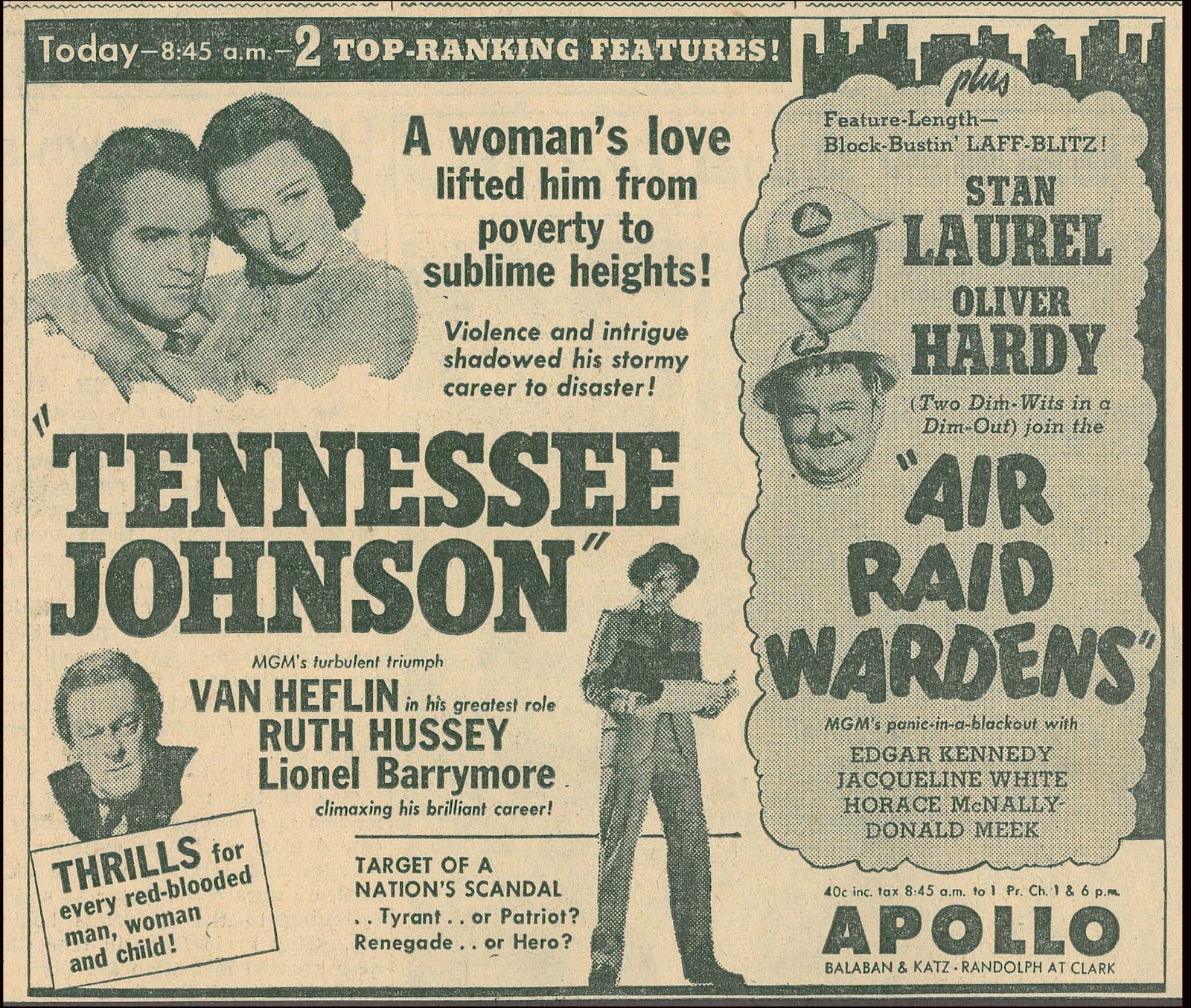
I’ve posted before on the comedies Laurel and Hardy did for 20th Fox. My problem with these is geographical. I’m just uncomfortable with the Boys off their home lot. Hal Roach was where they began and prospered as a team. Elsewhere the act seems out of place. Streets they walked/ran/chased in Culver City are as essential for me as L&H being there. You get to know that town’s landmarks for repeated use. Laurel and Hardy were as much about a place as times they represented. Books have tracked Roach locations, but few went exploring where Fox pitched cameras for the team. Music too was an essential. Take away Roach generated cues and L&H seem no longer themselves. My first picks collecting 8mm sound were their subjects with wall-to-wall incidental themes --- The Perfect Day, Brats, Hog Wild. Fans watch beyond perpetuity at least in part for music that is, for me at least, forever. Pondering why they declined is partly explained by loss of that accompaniment. This plus undeniable fact of Laurel and Hardy getting older. Hal Roach probably turned the duo loose as much for that as for fact he was moving toward other late 30’s direction. Stan got heavier as he aged. You see it as early as Swiss Miss and Blockheads. Babe’s was no longer the solid (if portly) athletic weight maintained on golf courses. Their increased schedule live touring and (minimum) nine-to-fiving at Fox gave him less time to counter evening cocktails with healthful traverse over the links. What age did to their appearance made Stan and Oliver’s act seem exhausted, but no team possessed such reserves of a public’s good will. Pressure was less during road tours, for merely seeing Laurel and Hardy was thrill a-plenty for customers who’d loved them since the 20’s. Stan wrote a sketch or two they’d perform with little more than a desk and a couple of chairs, knowing perhaps that just being there got the job well enough done. Theatre ads I’ve found for Laurel and Hardy in the forties generally find their Fox/Metro comedies playing second on double bills. Ones shown here represent Chicago first-runs for Air Raid Wardens, The Dancing Masters, and The Bullfighters. In terms of revenue, MGM’s features during this period, Air Raid Wardens and Nothing But Trouble, performed well below half of what Abbott and Costello delivered with three they did for that company (for instance, Lost In A Harem earned a worldwide $3.6 million to Nothing But Trouble’s $1.5).


Movies were tougher for L&H because competition was faster and, here’s a key word, bawdier. Abbott and Costello were aggressively co-ed. So was Bob Hope and patter types like him. They brandished (comparative) youth and sex overdrive to constantly remind wartime patrons of what everyone was really fighting for. A&C had transitioned from burlesque stages to filmmaking ones. I’m a Baaad-Boy Lou spoke the language of audiences reading between comic lines for smarmy jokes underlying. Funnymen at war were expected to be girl crazy and ever alert for the score. Bumbling Costello was never so much so as to abandon his wolf whistle. It was wrongest timing for an essentially asexual team like Laurel and Hardy. Not reliant on cheesecake or leg art before, now they were garlanded with it. Fox campaigning sat the team beside ingenues less associated with the films than necessity of skirts upraised and body profiles shifted sideways. Laurel and Hardy were slaves to fashion by other means incomprehensible to present-day fans and DVD purchasers. For us, there’s no accounting for Dante the Magician as billed-above-the-title co-star in A-Haunting We Will Go, his name and image sharing unearned prominence with Laurel and Hardy. Had the studio got round to elevating L&H to an A picture, I’ll bet it would have been in support of players then perceived as more important (Jitterbugs coming a year later might have found them listed below Vivian Blaine). Maybe it’s as well that Laurel and Hardy finished with Hollywood by the mid-forties. Were it possible to change the course of careers sixty-five years hence, I’d have at least put more songs into L&H Fox/MGM comedies, for there’s much dead air in ones we have. And I don’t mean tunes by guest artists. Laurel and Hardy were well up to singing and dancing. That was demonstrated in features for Roach and The Flying Deuces. Music plus the old routines would have easier carried the day, even if it wasn’t beloved Hal Roach themes we were hearing. So where do I come off trying to rewrite increasingly ancient history? Chalk it up to endless fascination of Laurel and Hardy, I suppose. We either love these two or are utterly indifferent to them. Ones among you who’ve stuck out this post should be well rewarded with purchase of Scott MacGillivray’s book. He has exhaustively covered what I’ve merely touched on here. Laurel and Hardy: From The Forties Forward represents the best scholarship I’ve come across about this team.