Life Begins For Greenbriar Picture Shows

After struggling five years with a too-often recalcitrant Blogger system, it looks as though happy days are here to (hopefully) stay, thanks to a brand new blog editing feature my online host has introduced. This is so much easier to use than a predecessor that more than once took hours to upload, and even then looked unlike what I'd hoped for. Now it's possible to caption photos, properly space paragraphs, and feature ads/stills without seeing the whole structure collapse once up and published. Best of all, I can post LARGE images where needed, so there's more visual variety on the page. No longer is posting a dreaded chore to follow enjoyment of writing and selection of pics. By way of testing the new format, I submit most recently watched Spider Woman ...


In case you're fence-bound over lately released Blu-Rays of the fourteen Rathbone/Holmes mysteries, take a tip here and grab the set, which is in all ways an improvement on standard DVD's previously available from the same distributor. These transfers represent a best this series can look, which is to say, while not perfect, is miles beyond frayed prints of yesteryear and certainly past Public Domain wrecks visited upon 8 and 16mm collectors back when Niles and Thunderbird Films peddled same on narrower gauge. I for one like Holmes better than horror shows from Universal during  that same 40's period. They work as mysteries, chillers, and showcase for what this company delivered best on limited budget. Were theirs borrowed sets from "A" pics done previous? --- for none look cheap, ever


Among favorite aspects of the Holmes series is Universal's penchant for moody cast gatherings come still/promotion time. Always there were shadows for a backdrop, low lighting, intense expressions. I wonder how much kidding went on among Rathbone, Bruce, Dennis Hoey, and Gale Sondergaard when posing for these. The posters remain highly collectible, one-sheets routinely selling for thousands. I'd call Spider Woman a favorite Holmes, save for fact they're all wonderful and as easily viewed a twentieth time as a first. This was always a roughest-looking entry in televised days ... even "original" prints looked like dupes, but on Blu-Ray ... Spider Woman's a pip.


Yet another Holmesian disguise that should be readily transparent, but never is, except to criminal masterminds only momentarily fooled by unmistakable Rathbone profile and diction.

Among benefits of Universal's series was pitting Holmes against worthy opponents, thesping counterparts equal or nearly so to task of holding own with Rathbone. Repeat runs are easy on eyes, but mostly ears, for verbal jousting among players not too seriously engaged by proceedings at hand. I hear Holmes filming was jocular much of the time, and don't wonder at that.


Holmes has just stabbed a crawling spider in a darkened room with deadly accuracy and only a flashlight to guide his master-stroke. One of myriad delights in the 63 minute Spider Woman.

Also I read that Nigel Bruce was annoyed when Rathbone turned down Universal's offer to go another season with Holmes. The actor didn't want to be forever associated with the role. As things turned out, that boat had sailed. Kids to henceforth request an autograph from "Mr. Holmes" were peremptorily turned down by a Rathbone sick to death of this character he'd never rid himself of. Sherlock and horror films BR was occasionally obliged to do (for the $) would follow him like grim death right to the end.


Violent Saturday's on DVD

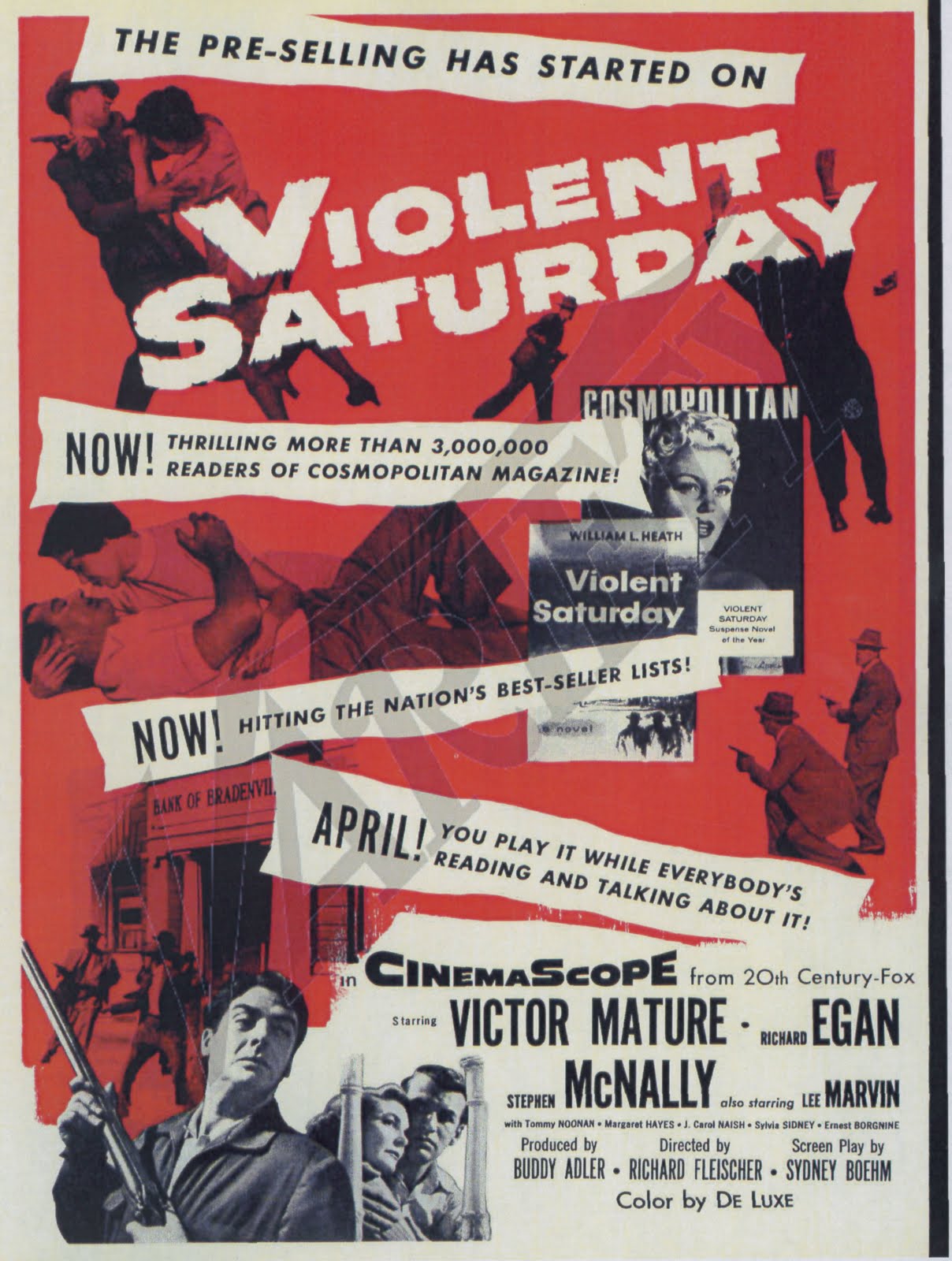
Recent DVD Violent Saturday comes courtesy a label formerly associated with soundtracks. Screen Archives has produced any number of outstanding CD's. Their initial DVD offering was The Kremlin Letter of earlier this year. A deal with Fox enabled that, Violent Saturday, and promised for later The Egyptian. Mixed emotion greets Violent Saturday due to its being released non-anamorphic widescreen, a format long gone to good riddance by collectors. We could wish for its delay till Fox generated a proper master, surely in the offing as their library makes way to streaming and On-Demand. Amazon already has HD Pay-Per-View on many early Cinemascope titles. Violent Saturday is too good a show to let languish in obsolete format. You can stream it today from Amazon at $4 per 24-hour access, but their version is unforgivably full-frame and wretched looking, so for the present at least, we're obliged to take Violent Saturday, imperfect as it is, from what Fox leased to Screen Archives. Question though ... how much more would it have cost to go ahead and do the upgrade? Would a niche following for Violent Saturday have justified such additional expense?


Violent Saturday is one you could easily show guests, being short-length (90 minutes) and reasonably quick-tempo'ed to a blistering pay-off that I'd bet still gives customer satisfaction (and has in 35mm revival runs, I understand). Director Richard Fleischer said in his memoirs that it was Fox's first Cinemascope pic to come in for under a million (negative cost: $958K). Fleischer had made a reputation with outstanding thrillers done cheap, including Trapped, Armored Car Robbery, and wide-hailed sleeper The Narrow Margin. Most recently he'd finished 20,000 Leagues Under The Sea for Disney, as high a profile release as 1954 yielded. MGM's Dore Schary offered Fleischer Bad Day At Black Rock for an encore, but Walt wouldn't let him off 20,000 finishing touches on Leagues. Part of this director's value to Violent Saturday was Fox's confidence he could deliver their show at economy rate and maintain quality as was case at RKO. Variety observed results and put Violent Saturday in potential sleeper class, but critical/customer breakout wouldn't come this time as it had for Fleischer on The Narrow Margin.


Part of dilution was contrived subplots that a trade said got in ways of an otherwise straightforward crime meller after fashion of not-long-before hit The Asphalt Jungle. Personal stories linking up and building to a bank holdup were maybe less welcome novelty in 1955 than to modern watchers always game for depictions of 50's family and community life in disarray. Violent Saturday presents an across-boards frustrated middle-class hip-deep in hypocrisies peculiar, we think, to atomic age dwellers. Had Nicholas Ray or Samuel Fuller directed, VS would be all over college syllabi and repeat pressed on Criterion disc. There's cultist catnip yet of Big Heat-ish Lee Marvin grinding a kid's hand beneath his shoe and stops-out violence when Ernie Borginine wields the business end of a pitchfork at the mayhem finish.


Interest was stoked for April 1955 release by tandem publishing of source novel by William L. Heath (his first) and its appearance in February's Cosmopolitan, said to be inhaled by fifteen million back when waiting rooms and barber shops doubled for libraries. Fox's strategy was to get the story quickest off pages and into theatres while still fresh in reader memories. That worked to tune of $1.3 million in domestic rentals and $1.5 foreign. Profit was $320,000, so it was good Violent Saturday cost no more than it did. Bloom was coming off the rose for Cinemascope by mid-1955. Grosses dropped as novelty wore off. The process was no longer a crutch for weak content. Untamed, The View From Pompey's Head, and The Virgin Queen each lost money, as did the season's lead "clinker," Prince Of Players, with its loss of $1.5 million. Foreign receipts often exceeded dollars taken by US theatres, even though, according to Variety, there were only 14,000 offshore venues equipped for C'scope as of autumn '55. The Violent Saturday novel was reprinted to joy of 1985 hard-boilers, and those who've read it call Fox's movie unworthy, so maybe it's as well I've not perused Heath's original. Screen Archives' DVD can be ordered from their website. Quality is OK for the compromised format it represents, while hope remains for a better (and anamorphic) release to come.


Book Choice --- The Lion's Share


New York Times movie critic Bosley Crowther wrote a book called The Lion's Share that was published in April 1957. It was first to attempt a history of the great Loews and Metro-Goldwyn-Mayer. Variety and the author's own paper gave Crowther positive reviews. He was long recognized as kingpin of film reviewers, having reached a peak of influence by 1957. BC is remembered for later missing the boat on Bonnie and Clyde and being eased off his desk as a result. Now if he's talked about, it's usually in terms of having been out-of-touch throughout much of a long (over twenty-five year) tenure. Crowther worked when critics mattered more. His signing a studio history was gilt-edged so far as credibility. What stories he'd tell in The Lion's Share would become standard text and source for authors to follow. Metro myths to die hardest began or were propagated by Crowther. Still, I enjoyed his book. Of course, better and more accurate ones have been done since. Sometimes though, it's worthwhile to visit movie history as it was understood when shovels first dug into Hollywood past. What Crowther did have was access to near everyone living at the time who'd been at MGM. 1957 was soon enough after a Golden Age for participants to look back fresh and lots more alert than what death or old age would later cancel out. For this alone, The Lion's Share is must reading.


The book was targeted to a mainstream. Dutton published and $5 was the hardcover's price. Crowther's manuscript was trimmed by 50,000 words to get The Lion's Share user-friendly. The author was known enough for a public outside industry to give a look, and that they did to reward of multiple printings over years to follow. Crowther's rather dry meticulousness (a Times review) went down smooth with consumers eager for straight Metro dope. Execs in that company found the book an intrusion, corporate battling a background to first sales of The Lion's Share. Crowther tracked Loew's from nickel origins to then-recent ouster of production chief Dore Schary. The latter was a cooperative interview and got sympathetic coverage in The Lion's Share, while earlier deposed Louis Mayer, still alive in 4/57, was beast and boor to Crowther's mind. Did the old man, then plotting (unsuccessfully) to take back his studio chair, give thought to suing for published slams? If so, I found no ink to confirm, and besides, Mayer had but months to live (August his exit), so maybe LB's concern was more to basics. Few would challenge the book's accuracy. Clark Gable was asked for reaction, and he said The Lion's Share reflected truth pretty much as he remembered. Enough doors opened to Crowther to make his a more-or-less authorized history. New York chief Nicholas Schenck sat down with him, as did Schary, David Selznick, numerous staff and luminaries who'd toiled for the Lion. Biggest help was Norma Shearer, retired and talkative for perhaps an only time after stepping off stardom's ladder. No wonder then that Irving Thalberg emerged most heroic of Metro minions, the most brilliant executive producer ever to work in Hollywood, according to Crowther.


The Lion's Share is strongest where it tells of founding Marcus Loew and how he built an empire up from storefronts. Weaving in/out of his story are dynamos who'd run rival firms. It's easy to forget how linked these people were starting out. Commonest thread among them was willingness to work 24/7 toward dominion of an emerging industry. Crowther goes easy on Adolph Zukor and Sam Goldwyn, both hale/hearty in '57, while passed-on William Fox is tabbed a notoriously savage lone wolf. Reviewers noted such restraint and decorum as Crowther applied in coverage of lions still roaring when his book was new. An author-updated (and unexpurgated) second edition would have been a welcome, possibly eye-opening read, as one can imagine what interview subjects had to say that Crowther dared not use at the time. Trouble with this book then, is the fact it does pull punches, aimed for light readership, thus no digging deep as we'd like into recesses of MGM. Still, it was heady backstage stuff in 1957, and a first truly revelatory peek behind scenes of a still-thriving studio concern.


I'd not take Crowther too much to task for untruths he repeated (or that originated with The Lion's Share). He was relying on what longtime personnel told him. Why would they lie after so many, even then, years? The Ben-Hur saga is related for probably a first time, emphasis on fact no lives were lost during its turbulent 20's shoot. Kevin Brownlow would revisit that topic in The Parade's Gone By eleven years later, some of his fresh interviews suggesting there were perhaps fatalities. There's a colorful recounting of MGM's struggle to get The Broadway Melody off starting lines. Early sound struggles are rich source here for triumph and tragedy. The John Gilbert "white voice" myth is hammered home persuasively. No wonder so many still believe that fable ... but who conveyed it to Crowther? Among those he interviewed was sound supervisor Douglas Shearer. Was this the culprit? There is odd reference to William Haines having had "a strangely high-pitched voice" as well, this complete balderdash as any of his starring talkies will attest, but how much access did Crowther have to these, and how much inclination to watch if he had? Trader Horn tales are told, including claim that Edwina Booth died within a few years of its 1930 release, thanks to illness contracted on African locations. It would be decades before we'd learn that Booth was very much alive and would in fact make it to venerable age eighty-six. All the forgoing was accepted as fact in 1957 thanks to Crowther's repute and fact he had palace keys. Historians have latterly set records straight, but that needn't diminish (by much) value of Bosley Crowther's pioneering work, still a worthwhile and entertaining read if one to approach cautiously.

Best books on MGM history? I'd nominate Scott Eyman's Lion Of Hollywood and Mark Vieira's Irving Thalberg. Both are tops for research/accuracy/enjoyment.