Book Choice(s) --- Walt's People


Here's how I found out Walt died: There was an afternoon kid show on Charlotte's Channel 9 where Joey The Clown ran cartoons, sometimes a serial, and chatted up local moppets often in cub scout/brownie gear. Joey wore greasepaint and red nose but seemed an ordinary 9 to 5 station man past that. In fact, there was melancholia to JtC I found compelling, this a clown who one day might really cry. On the December 1966 date in question, Joey nearly did when he stepped close as I'd ever seen to the camera's eye and told us a dear friend had passed on. The Winston-Salem Journal had gone up that day with Carolina Theatre ads for upcoming Follow Me, Boys, with Disney's personal guarantee we'd like it. So what would come of The Wonderful World Of Color then? Could there be Sunday nights without Walt? I don't remember how long it was before NBC retired his weekly lead-ins. Here was loss beyond mere celebrity departure. We knew Disney personally, or so it seemed for a face and voice familiar as any adult's and more welcome than most of those. My fascination with the man would make easy morphing Greenbriar into a Disney Digest where he'd be all I'd talk about (plenty of bloggers have). As it is, I'll go days reading/watching solely on WD, lately so with aid of newest in a fabulous book series called Walt's People, edited by Didier Ghez and made up of interviews with artists/executives/family members/imagineers who knew and worked with Disney.


Editor Ghez is mid-mission toward finding every interview extant on a topic I don't expect ever to tire of. These sit-downs make Disney films that much more interesting to watch, being ideal reading companions to Blu-Ray discs recently out. I'm on an Alice In Wonderland dig that will culminate with a GB two-parter down the line. Latest Volume Ten of Walt's People devotes to interviews Bob Thomas conducted for Disney bios published when recalls were fresher and many artists since gone were around to speak on beginning days at the studio. All this stuff is priceless and previously unpublished. Didier Ghez has his own Disney History site where you'll lose yourself in his outstanding research. It's there he provides updates on coming volumes and offers recent text/visual discoveries. Amazon has previous volumes of Walt's People along with newest # 10, each a treasure trove of information.


So allow me back into footie pajamas and reminiscence of World Of Color nights and Disney days at the Liberty. Ann and I just had lunch near what remains of the latter. Some thousand or so Sundays back, there'd have been lines up the block for 1:00's show of That Darn Cat, the roof fairly rocking over slapstick ungovernable but house-filling. Colonel Forehand would open two balconies for Disney shows. My first outing there, related before, was to see The Shaggy Dog in 1959. Two years later, a tick-infested cur presented itself and I named her Nikki after WD's Wild Dog Of The North. Disney somehow brings to mind limitless concessions, candy bars big as felled trees. Full-length cartoons were so-called, but often came in shy of run times live action accorded, so there we'd be relay-running with Yellowstone Cubs or hounds who thought they were raccoons. My mother fitted me in bow tie for our 1962 venture to a reissued Pinocchio, so most of what I remember about that show is a neck chafing. Sometimes Disney pics could be shockingly bad. Bon Voyage comes to mind. I'd walk out on Monkeys Go Home and declare myself well shed of live-action from Buena-Vista, but hadn't mere three years before found me rolling in aisles when Merlin Jones empowered a cat to chase a dog up a tree? My generation thought flubber the most uproarious concept movies yet devised. Would we find it so now?


A neighbor boy wrote Walt Disney in 1965, asking for his autograph, and a few weeks later received it. A sheet of note paper this was, like ones Walt was said to carry around at Disneyland for youngsters approaching to get a signature. Next time I see Lee around town, I'll ask if he still has his souvenir. But wait --- are these so uncommon? Walt must have given or mailed out thousands. (Autograph collectors please advise). Oh, and on that subject, I watched several Worlds Of Color at Lee's as ours contined its black-and-white orbit. Also there were gatherings before my aunt/uncle's 1961 RCA, installed in tandem with Disney premiere show (9/24). I remember Tinker-Bell dousing their 22" screen with paints and figured progress could never go beyond this. Programs ran hot/cold. A cartoon-dedicated night was best, while comic otters and Way-Out seals amused less. However mixed his content, there was at least Walt's intro to cap a weekend ... manys a night I'd tune in/out with his entrance/exit. Ann's been less enthralled with my Disney jabbering for what I realize is fact she was born in 1960 and too young to savor his weekly visits. It's doubtful I'd care nearly so much were it not for fact Walt spoke direct to me for those forming years. I didn't need an autograph to feel we knew each other well.

Favorites List --- The Gang's All Here


The Gang's All Here is the World War Two experience I'd like to have had, dressed in tailored uniform (resplendent!), cruising service canteens where Benny Goodman plays nightly and Alice Faye serves donuts, brief repair to South Pacific climes for handily won and bloodless combat, then return home, as does James Ellison, "covered with medals." Here's a Fox musical that's escapism in its most delirious sense --- engaging the enemy can wait, we've got a war bonds show to put on! Shows like The Gang's All Here convinced my generation that WWII was a pipe, allies having knocked out Germany/Japan between jitterbug contests. Watch and be persuaded that maybe all of life was better then, just never mind iron lungs, oxygen tents, polio still waiting to be cured, and such harsher 40's realities. The Gang's All Here ignited 70's camp-fires partly because this was how we assumed life was in parent days. Wiseacre youth at revivals figured old-time director Busby Berkeley knew not real meaning of enormous bananas his chorus brandished, unintended sexual subtext only we could divine (how readily moderns assume naïveté on the part of past filmmakers). Then there's Carmen Miranda and Technicolor, both registering vibrancy beyond even what buffs imagined. The Gang's All Here's reissue may have been a first recognition of dye-transfer coloring's superiority, and one of the last in which properly calibrated IB prints ran beyond isolated archive or revival house setting.


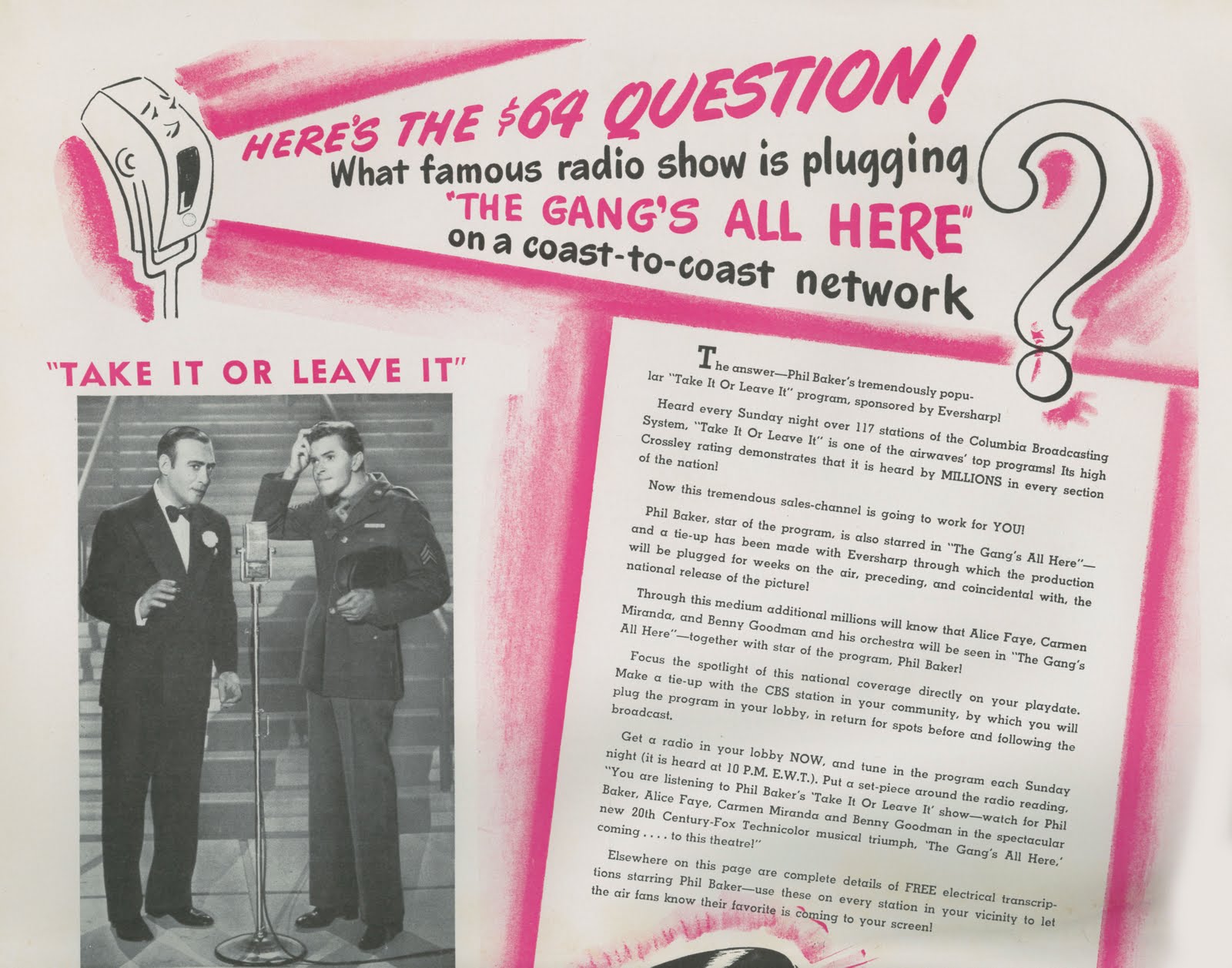
It's seldom you see a purple station wagon with wood side paneling, but there's one in The Gang's All Here I'd proudly drive. Changed times dictate women shun a coat like Carmen Miranda's from which four chinchilla heads dangle, but ... them were the days. Little (no, big) things I notice are live oxen pulling a sound stage cart during outsized number The Lady In The Tutti-Frutti Hat. Did they dine at Fox's commissary? The Gang's All Here is rife with dialogue Eugene Pallette calls Jukebox, enforced gaiety wherein everyone laughs as punctuation to everyone else's line. There is Phil Baker reminding us how entertainment was very much a different animal in 1943. He was better known for hosting radio's Take It Or Leave It, a sampled online episode ID'ing this as precursor to TV's The $64,000 Question. Baker was a fast-patter-er who let go vaudeville's accordion for airwave hosting and occasional foray into movies where his brand of glib might register. Take It's deal with Fox traded Baker on screen for Gang's All Here network boosting, a mutual back-scratch irresistible to patrons seemingly planted before screen or radio for most of waking hours.


Notice how aggressive male suitors are in WWII pics? Limited leave time and urgency to couple quickly made for courtship approach just 2011's side of sex harassment. Is this further fuel to distance PC inoculates from old Hollywood? James Ellison starts on relentless gear with Alice Faye and ratchets up from there. Did this sort of technique ever work in real life? (certainly not for me). Part of getting in Gang's groove is acceptance of ... no, revel in ... societal rules we abide being violated with brassy gusto (big yes to those chinchilla heads!). Biz-benefits of this war included soundstage doors wide opened to veterans whose acts were so old as to seem new again. Charlotte Greenwood's high-kick dance is spotlighted as if it had never been done before, and Edward Everett Horton gets close to star turns he'd enjoyed at RKO in the thirties. EEH and Eugene Pallette are, of all things, likeable Wall Street lions getting up a mansion rally to sell bonds. Pallette looks enormous even by relaxed modern standards, his scarlet-flush, rolling perspiration, and involuntary coughs suggesting a player ready to collapse under intense Technicolor lighting.


Alice Faye seems disinterested in The Gang's All Here. Did she sense an end nearing for her kind of Fox musical? I understand there was some secret reason for AF leaving 20th after Fallen Angel a couple years later. Her own dark referral to the split during interviews made me wonder if personal animosity toward Zanuck (an unnamed incident?) led to parting after ten years. I saw Faye once at a Hollywood Cinecon, signing autographs before a long line. Something about her expression made me not join them, for what could the meet be other than perfunctory? I remember how leathery her features were, as if this were first afternoon off a Palm Springs golf course in years. Now I could wish to have waited my brief turn, and brought away a closer view and maybe better impression of a personality who'd survived her peak by fifty years and counting (Alice Faye died in 1998). The Gang's All Here is currently available On Demand from Amazon streaming in High-Definition, looking best I've seen outside 35mm Technicolor and way superior to DVD's Fox has so far issued.


I'm a White Zombie Zombie


At what point do you fall asleep when watching White Zombie? For me, it's about the half point, where Bela Lugosi and assist are removing Madge Bellamy from premature crypt-ternment (that's not a word, is it?). No matter how long I'm out, it always seems they're waiting in that mausoleum for me to rejoin them. All us White Zombies have patience in common. Those 1932 shadows permit me to drift thither/yon and not really miss anything. If White Zombie had a European director, it might enjoy Vampyr's reputation and maybe a Criterion box release. They both work on me like sleeping powders (not to say I don't revere them). So where does Greenbriar come off posting on a film Gary Don Rhodes wrote an entire book about? Well, partly it's fact I've come increasingly round to placing White Zombie among personal Top Five of all 30's horror, a status it could not have achieved in boy days when stations, at least around here, never ran the thing. Again I'm on ground well trodden by others. Has any so cheap a film been covered as extensively? Many cite fairy tales qualities in White Zombie. "Dream-like" has been bandied (having taken me there, I'd concur). Some call it poetic. I'd label White Zombie insistent in its fascination, where all that is good rolls triumphantly over much that isn't. Our generation will have to take White Zombie with us, as I don't look for younger ones to willingly pick up this banner.


Fans of White Zombie are protective of it. They know what they're up against. Late historian George Turner wrote of how he followed WZ from 1932 first-run through multiple screenings at LA's Regina Theatre of reissue legend. Dick Bojarski chased white zombies through Brooklyn flea pits during the late forties, and Arthur Lenig, author of definitive The Count, says he was first to hail it a classic. Bill Everson was a notable champion in his 1974 book Classics Of The Horror Film. They all had to assume a defensive posture in the face of mainstream disdain for White Zombie, exemplified best by a November, 1970 New York Times piece wherein Vincent Canby used terms like immensely absurd, unintentionally funny, and so on to describe a revival booking wherein White Zombie played in support of Freaks (WZ being of a much lesser order than its screen companion, he'd add). I read Canby's smack-down at age sixteen, long before White Zombie came into my life and just assumed he was of a Steven Scheuer persuasion that classed all horror films as junk. Well, hadn't we grown up resigned to such placement by a stuck-up critic's establishment?


Part of White Zombie's appeal comes of its (some say) wretchedly antiquated technique and hard-luck cast. The fact gold was spun of all this is wondrous. Madge Bellamy and John Harron are actors you might imagine plunging into an abyss with zombie unfortunates in the film's final scene, so critcally reviled are their performances. These two did much to foreclose serious recognition for White Zombie, and to some extent, still do. Yet there is minor player Robert Frazer, barely known for much else, giving a good account of what's actually a role of some depth. His foray to Lugosi's sugar mill is perfection itself, a blessed segment for which you'd otherwise forgive White Zombie anything. Sound is put to remarkably creative use throughout. When did filmmakers stop exploring creative possibilities of that new medium? White Zombie does startling things with noise, whether it's cane being ground or a wooden box pushed into a burial vault. Stock music was borrowed from the Lord knows where and works beautifully for not quite fitting situations on screen, while rented sets lend grandeur not expected in a quickie (11 days) with a $62K negative cost.


Bela Lugosi figured they made millions off White Zombie, "they" being the independent producing Halperin brothers. BL managed on short change somewhere north of $750, though likely less than four figures. It galled Lugosi to watch White Zombie on 50's television and know he'd not realize one cent for broadcasts. Many old-timers were of like mind, having performed for flat fees and shut now out of residuals. Lucky teen boys who'd befriended Lugosi would join him tube-side for White Zombie and others of his inventory. Just imagining such makes present day fans swoon. There's really no more a definitive Bela part than this one. Never did he look better or exhibit greater command. White Zombie made some folks rich by 30's standards. Certainly there were profits beyond what even major studio horrors earned. The skinned-to-bone budget was assist toward that. Domestic rentals of $252K and foreign adding another $118K amounted to happy payday for (presumably) the Halperins and distributing United Artists. White Zombie stayed in more or less perpetual release from there on. Houses big and small filled dates with it ... many used WZ as screen lure with on-stage spook acts, some with Lugosi himself in leaner times. Our Liberty Theatre brought it in for a July 1947 date at flat rental of $20 (Charlotte exchange Kay Films being payee). 35mm leasing was handled by Sherman Krellberg, who roamed dealer rooms at collector cons into the seventies (hoping, no doubt, to work one last con of his own). Video peddlers got interested when fans requested White Zombie in something other than muddy prints. A laser disc from the Roan Group finally put things right as possible (considering a long gone camera negative) and their release got mainstream press attention that was a near-first for humble White Zombie. The Roan disc remains best of the many WZ's in circulation (their DVD an improvement even on a mid-nineties restoration the Roans oversaw).