MGM's Remake Rally of 1956


1956 was the year MGM fired Dore Schary and let their pre-48 backlog go to television. It was also a parched season when most of what they released lost money. I don't know of anything short of geese laying golden eggs that could have survived such a drought as theatres suffered then. A lot of what Metro did was remake or reissue old properties. Sometimes that worked, more often it didn't. The Philadelphia Story came back musicalized as High Society and was a hit, while The Swan with Grace Kelly reprising Lillian Gish's 1930 performance lost $764,000. A Cinemascope'd updating of The Women called The Opposite Sex ran aground with $1.5 million gone. These last two intrigued me for stills found on both during Liberty storage searches back in the seventies. I wondered then how such things performed new in 1956, but wasn't inspired to watch either on televised pan-and-scan. What's worse than wide movies on a square tube? Warner Archive has lately released The Swan and The Opposite Sex on anamorphic DVD with bounce-around-the-room sound (that last a good thing). Both are gorgeous transfers that transported me back among sweet seats at 1956 flagships where they played as intended and hadn't again till now.


Very poor business. Metro has gotten so "arty" in the past few years that Leo's trademark on a newspaper ad is almost enough to kill a picture, said manager Jim Fraser of Red Wing, Minnesota's Auditorium Theatre. He was talking about The Swan, and for 104 minutes viewed last night, I sort of felt his pain. How old-hat was this in a year when Elvis hit and restless youth were shucking off movie choices parents made? Put yourself in Jim's place ... here's a show dusting off a play first performed in 1923, with Grace Kelly clothed to the neck and coldly patrician besides. She'd married Prince Rainier in April '56 and that was primary hook for merchandising The Swan. For comparison's sake, I looked at One Romantic Night, the 1930 Lillian Gish version also just released by Warner Archive (guess MGM acquired it with remake rights). Turns out this one, at 72 minutes, has more energy than 1956's successor. The Swan is a comedy of manners revolved around royal amours and class conflict, riveting stuff, I'd imagine, if you're descended from crowned heads, but deadly for patrons in blue jeans or pedal pushers. Most of the $1.7 million it earned (in domestic rentals) likely derived from urban carriage trade, or maybe those curious to see Grace Kelly courted by pretend-prince Alec Guinness (who did favor Rainier a little). A location boost for me was The Swan's outdoor filming at Asheville NC's famed Biltmore House, a palace completed by George Vanderbilt in 1895 and truly fit for kings. I've walked enough through the joint with Ann (she'd live there if they'd rent) so that it seemed like home week watching Metro principals frolic about manicured grounds (but not amongst interiors --- those were built back in Culver).

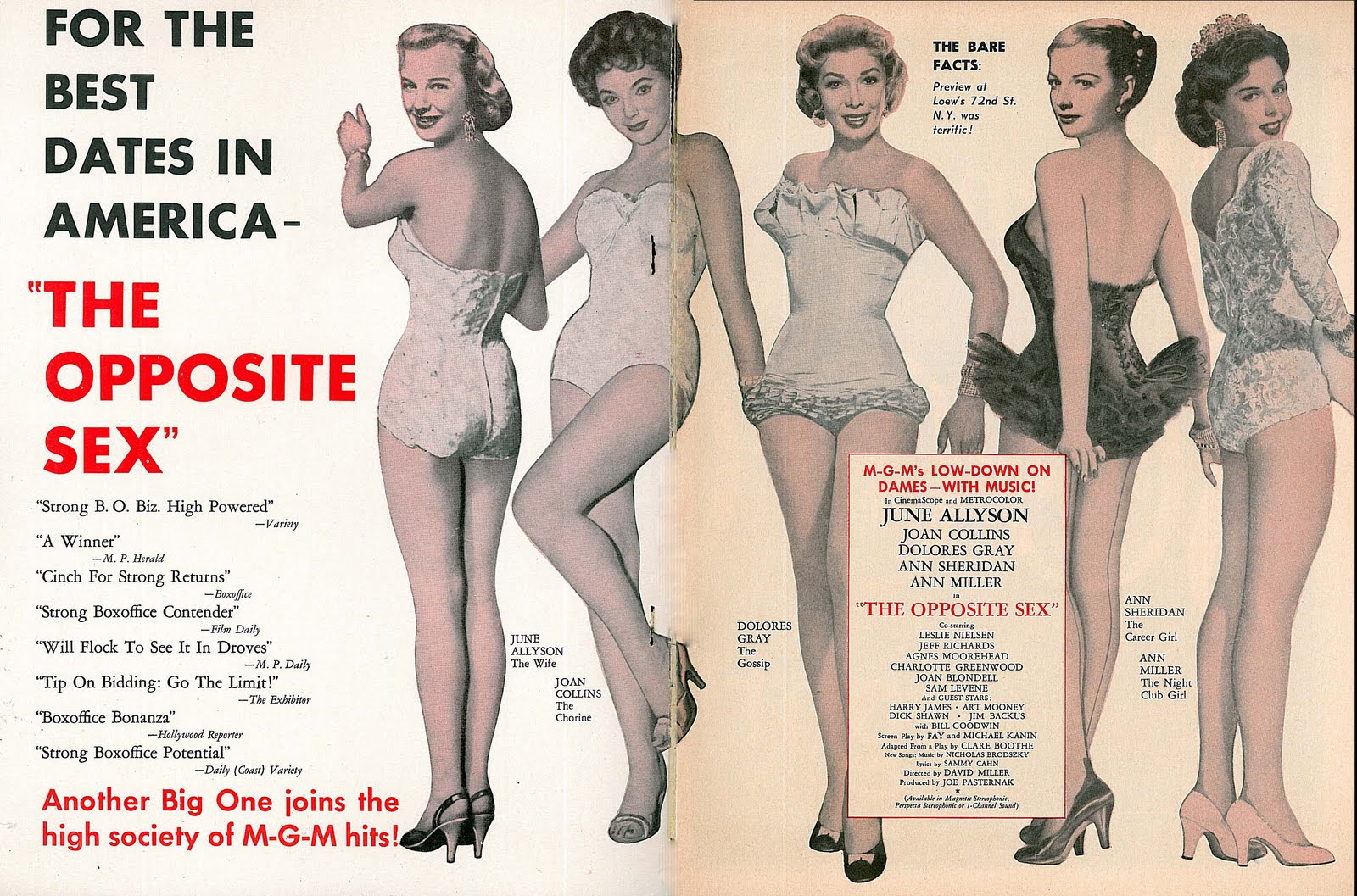


A filler spot on TCM told how June Allyson swung on Joan Collins while they were making The Opposite Sex and knocked some teeth out. It was accidental, but happily stayed in the print. Watch it now and you'll see (and hear) Joan's earring flying across the room as well. Allyson/Collins battle memories of Norma Shearer and Joan Crawford in 1939's The Women in addition to each other. The original was largely unseen since MGM tried a 1947 reissue ($162,000 in worldwide rentals), and now came time to jazz up same with color, expanded frame, and a cast including men, their sex verboten in the oldie that resolutely maintained conceit of femmes only for its 133 minutes. Turns out that template was friskier in situations and dialogue (1956 dropped, for instance, a noted exit line about names for ladies not used outside a kennel --- had Code restrictions tightened since 1939?). Cinemascope still in comparative infancy played havoc with actress faces and fashions. Figures go squat and dresses already expansive billow like circus tents. I might have done something better with June Allyson's hair using toenail scissors (and she utterly blows Norma's blockbuster "jungle red" line). Dress and deportment had evidently gone a long way (down) since 1939. There's just no consistency in the designs, as if every shop window had been raided willy-nilly. We can guess this was MGM's 1956 idea of what smart women wore, but how did real-life smart women respond? Metro sent starlets cross country to model outfits from the film and stir up interest in same when what they really needed for The Opposite Sex was a producer with Ross Hunter's fashion sensibility. He knew how to render rags glad and make women want to wear them (and consume films in which they were worn).


Too many shows out of a studio system in decline tried too hard to please everybody. Instead of going forward in confidence, even with a set-up that worked before, they'd plump up as if staging a Ziegfeld Follies. Such excess breeds fun in The Opposite Sex, where more always ends up amounting to less. June Allyson has a back story where she entertains at World War II camp shows with cameo guest Harry James, and later Jeff Richards rocks out with a cowboy number that for all I know charted beside Little Richard and Bill Haley. A truly weird and would-be comic interlude featuring Dick Shawn and Jim Backus only adds to a whimsical anything-might-happen flavor. Veterans (Ann Sheridan/Joan Blondell) who'd have been ideal as 1939 Women now play in support of Allyson, Joan Collins, and Dolores Gray, the latter succeeding (respectively) Shearer, Crawford, and Rosalind Russell. When in doubt (often) as to these ladies' properly filling heels of forebears, The Opposite Sex brakes for outsized production numbers joyously out of keeping with a story they're trying to re-tell. There's pleasure here (never "guilty" --- as I don't acknowledge such things) of watching a train jump tracks and careen down a mountain side, so polluted is The Opposite Sex by committee-driven mentality. Credited director is David Miller, who I'd envision being overruled as to everything he tried to do right (exemplary work on Sudden Fear four years earlier was his). The Opposite Sex is another for those who've seen the classics and are ready to revel in the dregs. It is beautifully served up by Warner's Archive (as is The Swan) and well worthy of view time just for fact we can finally experience something very near what 1956 audiences did.

Spreading More Deanna Love


Universal recently (and quietly) issued another Deanna Durbin Collection on DVD as part of their TCM Vault series. This time it's five rather than the six titles we got in a "Sweetheart" pack of several years back, with pricing on Volume Two a deal-breaker for many at $69.95 retail (the initial half-dozen came delivered at $26.98, before discounts). Classic DVD is getting to be a boutique enterprise. If you want a lot of this stuff, get prepared to pay for it. A question just occurs to me ... did Deanna Durbin ever negotiate for profit participation in her films? Given she was Universal's principal asset for over a decade, wouldn't there have been a clause, at least in mid-to-latter 40's contracts, for a piece of turnstiles action? She'll be eighty-nine in a few weeks, by the way. I'd like to think there's a slice of my purchase $ winging to France and payable to venerable DD, just for sticking around so long and entertaining me (and hopefully some of you) with musicals still best in their category.


And what do we call Deanna's brand of amusement? To me, she's tops among screen underpups, that legion of girlish songbirds Hollywood once issued in such abundance. They seem alien to a current public that hasn't seen their like in generations. When did adolescents last go vocal in movies, let alone achieve stardom for doing so? I guess most recent (recent?) was Jane Powell. Should we blame their extinction on a culture's loss of innocence? (though I don't buy notions we were ever really "innocent"). A thing that impresses me reading about Durbin is her stability through celebrity's grind. The girl dodged improvident moves you almost expect from cover teens today. Not for a moment does she seem to have bought into studio foolishness, all the more remarkable in light of intoxicating effect a dream factory's angel dust had on late 30's/early 40's psyches. There was a Fortune magazine article in October 1939 called simply "Deanna Durbin," as if that were shorthand for money, which as of then and years after, it was. Unlike fan rags with their dribs and drab of truth, this was a profile written for serious dollar merchants to whom picture stars were ordinarily ephemera itself (I'd guess Fortune subscribers shunned theatres because there were no ticker tape machines in lobbies). Fortune laid down statistics normally withheld from film-followers, to-wit fact that Durbin's output had been accounting for seventeen percent of Universal's entire yearly gross. She'd been credited with putting that company into unaccustomed profit as well, after repeated seasons of near-bankrupt performance.


Did Durbin really save Universal's hide? Well, she certainly thrust them into bigger theatres, being a first contract player that could, and on a repeated basis. It got to where lines formed for whatever she did, and according to Fortune, Universal was for a first time able to increase percentage demands for first-runs from a maximum twenty-five to thirty-five percent of paid admissions. This was rarefied air for a purveyor of mostly westerns, serials, and B actioners. A thing I enjoy most about Durbins is fact of their being Universal pictures, with unmistakable look and sound attendant upon that. One from last night's viewing was the 1938 Mad About Music, set in Switzerland by way of village backgrounds congenial to Uni monsters long known and loved. I half expected bicycling Deanna to whistle past Wolf Frankenstein's castle retreat (perhaps to Ygor's shepherd horn accompaniment), so much did Mad About Music's art direction remind me of the following year's Son Of Frankenstein.


Durbin would soon turn eighteen when the Fortune article hit. Had I been her, there might have resulted a Take It Or Leave It contract renegotiation with Uni chiefs, assuming even half the content of said piece was on the level. Did any personality back then, let alone one of tender years, possess such bargaining power? Among things wonderful about these DVD's is how lush Durbin vehicles are, all the more so now that they're decently pressed from original elements. Universal didn't splurge often, but when they did, watch out. From penny-pinching over decades came expertise at stretching dollars that's delight here to behold. Three Smart Girls Grow Up opens with titular trio tracking through mansion environs (clear that Universal's just showing off for downtown palace audiences) toward the money shot of a formal gathering to overshoot entire cowboy and monster budgets elsewhere on the lot. It helps watching these to like Deanna's voice (in fact, that's essential). So happens I do, plus her admittedly go-get-it personality. That last can rankle if you don't cotton to aggressive adolescents, though Durbin tempered hers, knowingly I think, by adding piquant sex allure as soon as she was able. That last made her adult transition easy, as Universal put off transition toward maximizing viewer eagerness to see Deanna cut loose re girl meets boy. That she does in this set's Because Of Him, where she applies seductive wiles to unlikely partner Franchot Tone (hardly boyish ... he was sixteen years her senior) and reworks comedic bits with again co-star Charles Laughton from 1941's It Started With Eve. You'd think by obscurity of these shows that none amounted to much commercially, but au contraire, they were all hits to her last, and Universal cried real tears when Durbin finally closed the iron door in 1948.


Deanna wrote me once (in 1986). Yes she did. It was just a note acknowledging a flyer I'd sent for our Film Den show of First Love, but here it is, and from what I'm told online, she's no longer responding to fan mail (so much of it, with internet advent, as to finally overwhelm her). That last got me wondering if DD has a computer and maybe follows activities of her web-based fan legion (considerable). There are folks my age who refuse to acknowledge the keyboard monster, so how would this woman who chucked stardom sixty-plus years ago feel about it? I do hope she has a DVD player so as to watch these Universal volumes that are so superior to 16mm prints she's understood to have owned since Hollywood days (but how many of those have turned vinegar during the interim?). Durbin spoke to sound reasons for retirement in that one-off interview she gave David Shipman in the eighties: Why did I give up my career? For one thing, just take a look at my last four films and you’ll appreciate that the stories I had to defend were mediocre, near impossible. Whenever I complained or asked for story or director approval, the studio refused. I was the highest paid star with the poorest material ... today I consider my salary as damages for having to cope with such complete lack of quality. Interestingly, her final film, For The Love Of Mary, and yes, about as lame as she obviously found it, is among the recent DVD's. Others of the five include aforementioned Mad About Music, That Certain Age (Jackie Cooper for puppy love, Melvyn Douglas as suave object of DD crush, and my fave song of hers, You're As Pretty As A Picture), Three Smart Girls Grow Up (maybe her richest looking vehicle, and a good one), Because Of Him (Laughton and Tone reunited ten years after sailing the Bounty ... Deanna works well with both), and reviled, but still fascinating, For The Love Of Mary.
More Deanna Durbin at Greenbriar's Archive: Her Glamour Starters Part One and Two, plus Deanna, How Could You Let Them Do This?, and Deanna in Technicolor.

Comedy Curiosities --- Part Two --- Boeing, Boeing


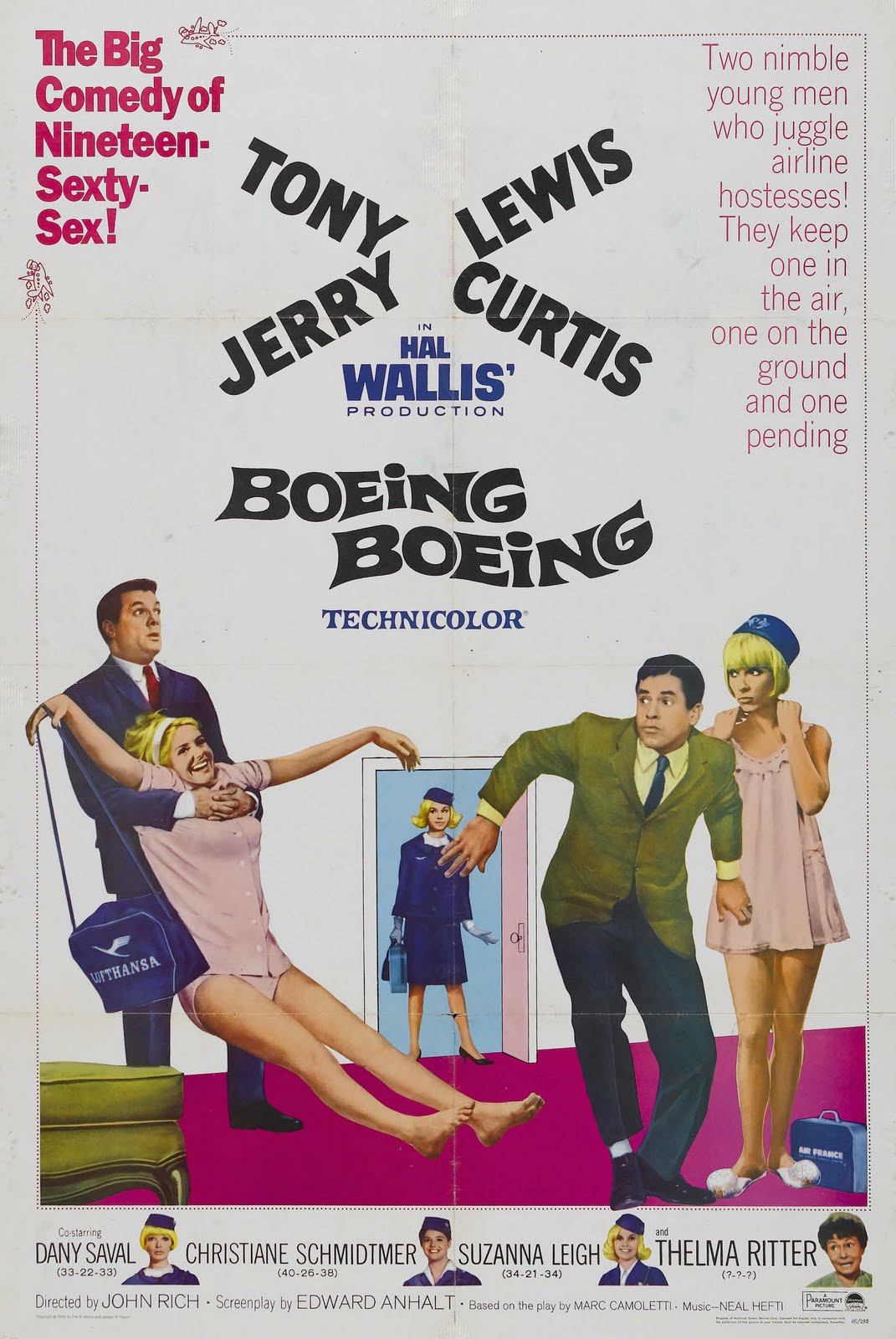
Boeing, Boeing took on added interest after all I'd read about its troubled production. That's often the way with fabled disasters you can't wait to see once supplied with behind-the-scenes knowledge. There are several places to go for accounting of Boeing, Boeing travails. Tony Curtis' autobiography is a start. Then there are Hal Wallis' recollections. Director John Rich talked about Boeing, Boeing in a book he wrote called Warm Up The Snake. Reams on Jerry Lewis are out there to reference, Shawn Levy's the most rewarding. Fans go for tawdry 60's show-biz like flies to a light bulb. Then-stars on the fade seemed to have no idea theirs was an era dying fast. Would Tony Curtis and Jerry Lewis have misbehaved so on Boeing, Boeing had they seen decline waiting around a late-sixties corner? Their kind of movies were packing it in even as last of them were made and released to a public past indifference. The two convened a League Of Nations to settle billing dispute for this, their first (and only) as co-stars. As neither would cede first placement, it was suggested their names spin propeller-like during Boeing, Boeing credits so neither would dominate. Poster art found them billed criss-cross, symbolic perhaps of Curtis and Lewis being at cross-purpose with a changing culture, though "Tony" got favored left position, an advantage I'm sure Jerry noticed and dutifully complained about. Both these guys were sat aboard a bobsled and which one topped marquees should have been least of their concerns. Ego was long since an engine driving them (not that C&L were alone in that). They were way down a list of preferred talent for Boeing, Boeing in any case, as producer Wallis and director Rich hoped initially to cast Dean Martin, Jack Lemmon, Dick Van Dyke ... well, almost anybody else. A sense of Tony and Jerry as hot names cooling off was surely palpable by the time Boeing, Boeing began shooting in May 1965.


Hal Wallis was an old man retired by 1980 and published year of Starmaker, but seethed still over antics indulged by his Boeing, Boeing co-stars. Curtis and Lewis were spoiled rotten by his definition. One mid-production memo referred to them as sick people. OK, let's consider that. Does celebrity indeed warp a human mind and spirit? You'd think so based on ways Jerry Lewis treated (and continues to treat) people. A movie star's truth is different from yours and mine. They just don't see things like we do. One Boeing, Boeing anecdote Tony Curtis told in his memoir was jolting reminder. On Jerry's wild and crazy on-set ways, TC had this to say: If the camera was just on me, (Jerry) would drop cigarette ashes on my jacket in the middle of a scene, or reach down and quietly unzip my fly. Now, a moment please ... let's reflect on that last part ... Reach down and quietly unzip my fly?!?! Surely among gestures that would alarm, Jerry Lewis unzipping one's fly, quietly or otherwise, ranks near a horrific top. Could Tony have found his later research to play The Boston Strangler any more unsettling than this?


So much money got frittered away on Boeing, Boeing. Scenes were filmed in Paris and Curtis/Lewis used that occasion to bleed white Paramount's expense account. So what was up with Lewis and seventy-five pieces of luggage? Was this to assert his star's prerogative? John Rich said one steamer trunk was just for Jerry's socks (cue well-known fact that JL never wore a same pair twice). Both he and Curtis took random leave of Boeing, Boeing's set without explanation. Studio underlings sustaining brunts for all this must have hated the pair's guts. There seemed always to be war ongoing between Tony/Jerry and Paramount brass over some or another point of order. Jerry's relationship with the studio was a vessel sinking. Now that his pics weren't doing so well, they were giving back as nasty as they'd got (for a past decade and a half). Curtis riled Wallis by demanding a wardrobe person be on the set at all times to take his coat whenever he removed it, a silly gesture sure, but one Tony recognized as emblematic of power and who wielded it. There were also squawks over make and model of limousine he'd be chauffeured about in. I suspect what others dismissed as gratuitous ego tripping made sense (if imperfect) to a star aware of how tenuous his or anyone's grasp of fame is. So much that seems absurd to us now was, in 1965, combat intense among power players jousting for an upper hand, but what of livelihoods imperiled throughout lower ranks, like the guy driving the Cadillac Tony rejected because it wasn't a right color, or the schlep they assigned to catch his coat before it hit the stage floor? I don't wonder that so many spoke of such incidents with oft-justified bitterness even after years had past. Sometimes it was minor aggravations that were most revealing. Director Rich told of Lewis causing delays by cutting off Curtis' tie with scissors and obliging the latter to change wardrobe. Rich warned Jerry that similar liberties with him would yield a swift kick to the groin, to which Lewis reacted with genuine surprise. Still, Tony Curtis at least looked back on Boeing, Boeing as a charming movie, and called working with Jerry wonderful (the greatest comedian of our time --- and I ate him up alive ... huh?).


I'd always assumed Boeing, Boeing was a dog. A boy in sixth grade called it Boring, Boring. My interest in Jerry Lewis was mostly nil in 1965-6, save The Nutty Professor and Martin/Lewis pics turning up on NBC, while Tony Curtis was, for this eleven-year-old, Houdini and not much else. Fans of Jerry disliked Boeing, Boeing because he played it largely straight. A lot of them were drifting wide of Lewis in any event. Boeing, Boeing made five or so years earlier might have scored better than $2.4 million in domestic rentals, a sum disappointing but maybe not surprising in light of Jerry's boxoffice erosion (The Family Jewels with $2.3 and The Patsy $2.0, these having followed The Nutty Professor's $3.3 million). Boeing, Boeing would be the comedian's last for Paramount. What he'd subsequently do for Columbia made for trying afternoons at the Liberty. I remember Three On a Couch and The Big Mouth on first-run weekdays, followed by reissues like Cinderfella and Rock-A-Bye Baby on various Saturdays. Those older Paramounts were lush as opposed to Columbia's habitual drab. Color quality revealed a marked difference. Boeing, Boeing was (is), for me, Jerry's finish in class pictures. On widescreen and high-definition, it can still entertain, given a viewer's thick hide for conventions of farce --- back-and-forth'ing through doors, relentless double shuffling between Tony and Jerry, etc. Actually, both stars are good, at least as good as source material permits (the play from which Boeing, Boeing derived was a hit on European stages, less so stateside). Curtis by 1965 had this kind of tomfoolery down to a science, even if his wasn't applied so deftly as idol Cary Grant, for whom advancing age was no impediment (TC was forty and that ice-cream face was starting to melt). For his part, Hal Wallis got the last lick at Jerry with concluding remarks on the Boeing, Boeing ordeal, to-wit: Later, Jerry got the autonomy he sought from the beginning. He produced, directed, wrote, starred in, edited, and supervised the music of his pictures. There is no need to comment on their quality.