Two Lost Worlds --- Part One


Last night, I came across the 8mm reel that started it all. The Lost World was one we (cousin, neighbor, and myself) pooled resources to order out of Famous Monsters #29 (aka Flesh Eaters edition). Should my purchasing partners come calling for respective third interests, it is here and ready to run. My viewing was a first in forty years. Somehow the image had dimmed, as though its black-and-white found a means of fading. We'd sent $4.95 to Captain Company in that summer of 1964. FM's ad promised The Lost World's dinosaurs to be the most realistic ever put on film. As of that year it was true, and easily borne out by inspection of a then-recent (1960) remake. Our Lost World was made in 1925 and effects were supervised by Willis O'Brien, King Kong's creator. We realized that going in thanks to Professor/FM editor Forrest Ackerman, and so bought with confidence. Those two hundred feet of The Lost World (originally a feature) accommodated four battles to the death among its prehistoric cast, so respective ten-eleven-fourteen year old dollars were wisely spent indeed. We ran it for nickel and dime admission in my parent's basement, sometimes in combo with Castle Films' Dracula, our accompanying purchase that season. I was surprised to find that The Lost World had been prepared for 8mm by Encyclopedia Britannica, an entity not otherwise given to endorsement of dinosaur battling, thus my explanation to parents that its acquisition was justified for educational values therein. Would Encyclopedia Britannica lend its imprinteur otherwise? Remarkable the efforts we made to legitimize a beloved, but disreputable, genre.


The Lost World's creatures were menacing but somehow personable. They snarled but also wagged tails (the Allosaurus subsequently broke his First National contract after losing too many parts to Dick Barthelmess). You knew the Brontosaurus would come a cropper for not being carnivorous (that's meat eating, ya know). He's noble but has a brain the size of a pea so gets eased over a precipice by the habitually anti-heroic Tyrannosaurus Rex. 8mm titles indicated the Bronto would die slowly in swamps below, but FM's FJA assured us that selfsame brute was not only revived, but let loose to flatten London bridge in a fuller dish Lost World he saw back in prehistoric 1925 (when people maybe had real dinosaurs to contend with). FJA alerted us as well to missing link ape-man Bull Montana, also resident of an unexpurgated LW lost to ages (mine at least). Ackerman published stills to verify what I might have discarded as myth. For years, there was no more Lost World for me than what that 8mm reel contained. Serious film collecting, which really just means more dollars spent chasing thrills that can't help diminishing as one gets older, finally yielded a dupe from a dupe off a Kodascope, the latter being authorized 16mm prints once sold for home entertainment. These boasted improved visuals and longer running time. Still, they were short by nearly half from what Forry J and kinsmen saw. The Lost World had been trimmed to essential bone by a distributor set upon adapting merchandise to saleable length. More than one fan developed O.C.L.W.S., which was Obsessive Compulsive Lost World Syndrome, a malady wherein the afflicted spend lives in search of missing Lost World footage, their quest as frustrating as Professor Challenger's for his elusive plateau. The stunner here was fact they actually scored the 1925 original ... well, at least most of it ... and reliable authority suggests even more Lost World nitrate has revealed itself since.

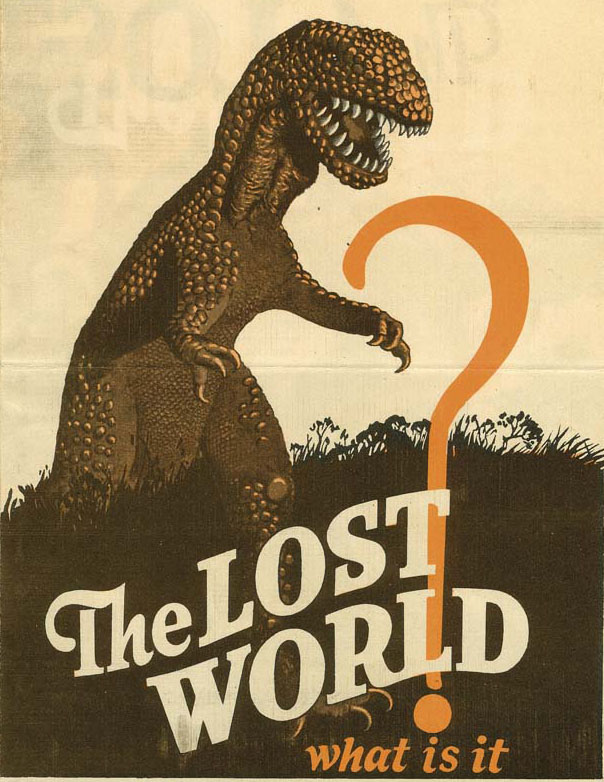


Forever, it seemed, The Lost World was anybody's show. Having gone Public Domain long ago, it's been plundered for nips and clips that even in truncated circumstance can delight newcomers. Like with Ray Harryhausen's output, these stop-motion puppets correspond to beats of our hearts. My generation (and ones before me) love them with greater fidelity than later crops are likely to maintain for impersonal Jurassic Park residents. Blackhawk Films and Griggs-Moviedrome sold what they could pull off Kodascope copies through the sixties and seventies. A grand culmination arrived with a near-full length Lost World unveiling at 1998's Syracuse Cinefest, said restoration having originated with George Eastman House. That version surfaced later on DVD as an extra with 20th Fox's remake, a bargain disc whatever one's reservations about the 1960 version. Now with more footage having turned up since the 90's rescue, it seems somehow appropriate that a fully intact Lost World remains beyond reach ... at least of any institution's willingness to spend yet more revisiting it.


So here's what dogged me for years about The Lost World: Why didn't Hollywood make more dinosaur movies? Well, we could ask the same thing of King Kong. You'd figure Willis O'Brien's phone would ring off its hook in wake of those two. I don't know how The Lost World sold in 1925, but assume it was a hit. Some patrons are said to have thought the dinos were genuine. At the least, First National had stock footage I'd think could be spun off into a hundred low-budget replicas, plus there was FX test film (included on Fox's DVD) that could by itself satisfy demands of a poverty row contender. Instead it was Hal Roach's One Million BC in 1940 that became one stop shopping for monster scraps, but his were blown-up lizards no more or less convincing than ones Irwin Allen decorated in 1960. I did read Scott MacQueen's American Cinematographer account of how rights to The Lost World shifted around after 1925, so I'm not sure what if any ownership Warner Bros. would have inherited after they absorbed First National, but wouldn't it have been neat seeing O'Brien's creatures popping up in sci-fi adventures right through a black-and-white 50's? I'm picturing Frank Lovejoy and Paul Picerni leading a Warners-backed expedition, with Joan Weldon or Phyllis Kirk lending girl scientist assist. Maybe Frank could wear a beard and look scruffy so as to match up better with Wally Beery's stuff. He and Paul could fight over Joan/Phylis just as volcanoes erupt and all those million plus thirty year old dinosaurs stampede across process screens to amaze a new generation of filmgoers. Somebody send me back to JL's office around 1953! I could give as persuasive a pitch as Daffy did in The Scarlet Pumpernickel.
Coming in Part Two: Irwin Allen's Immortal 1960 Remake of The Lost World.

Billy Wilder's Old-Fashioned Way


How soon they forget came home recently when a friend described his meeting with a studio development person who'd never heard of Star Wars. So is that where we are in 2010? Imagine then, how Billy Wilder felt when his 20's jokes and references fell flat before since born onlookers in 1974's The Front Page. Looking back ten years is chancy enough now ... imagine Wilder gag mentioning Leopold and Loeb, fifty years after the two made news. To him, these were current events. Billy the insider excluding us outsiders disdained a 70's zeitgeist and fell in the trap we all do of thinking our old days were the best days. He declared as much during interviews that got testier as decades and decline wore on: They say Wilder is out of touch with his times, said Billy, Frankly, I regard it as a complement. Who the hell wants to be in touch with these times? Fair enough ... unless you're asking other people to finance movies for a mass and, damn-them-all, modern audience. Billy had skated a cutting edge before. In fact, he'd done so longer than most any director working. I was looking over 1959 trades just yesterday: Some Like It Hot was just out and folks were raving. It was 20's set too but ahead of that time, as well as the decade when it was made. Wilder being fifty-three in 1959 had more patience with youth and maybe better idea of what they'd come to see. His winning streak of the period suggested he knew what all of us wanted to see. Some Like It Hot opened as Witness For The Prosecution came off months of hit-making and would be followed in a year with BW's redefinition of serio-comedy that was The Apartment. When in this business did any director measure so precisely the pulse of his public?


There were earlier setbacks that might have foretold The Front Page's fate had Wilder chosen to recall. His Spirit Of St. Louis reached back thirty years for its history and took lumps from kids who didn't know Charles Lindbergh from Krazy Kat. That had been 1957's miscalculation. It seemed to Universal in 1974, however, that a paying public was ripe for nostalgia. Hadn't The Sting struck oil? Well, yes to its customer's embrace, but no to their willingness for old-timers to broadcast memories of so far back minus ironic distance young(er) director George Roy Hill managed with characters distinctly hip despite their period garb. I watched that again recently and noted a little of the freshness Some Like It Hot once brought to snap brims and running boards, then calculated that Wilder was about Hill's age when he'd made SLIH. Where is the cut-off for directors being relevant? Not many in their late sixties ring bells for current youth (though I watched Frenzy last week, and well ... AH sure did with that one). Billy Wilder was like a lot of veterans who felt alienated by seventies' tastes alarmingly changed. It had taken that long for a counterculture to shake cobwebs (including his) out of an industry down for counts. The Front Page was pre-blockbuster era (that is, Jaws and Star Wars) when it still seemed possible adults would go to movies, thus Universal celebrated Wilder as Hollywood's last great apostle of the written word. Might The Front Page flash back to retro-fueled grosses The Sting enjoyed?


The Front Page wasn't a flop. It just wasn't enough of a hit. Wilder slowed down dialogue so he wouldn't lose current beneficiaries of public education (that very level Star Wars would seek and conquer), but misjudged appetites for profanities and vulgarity he'd been blocked from using over most of a career till then. Suddenly there were swear words flying every which way, so much so as to blunt the effect of a closing line Wilder treasured from the source play (The son-of-a-bitch stole my watch!). A lot of sex gab laid heavy on attempts at gaiety, something The Sting had neatly avoided by keeping its humor nearly G-rated. Wilder clearly enjoyed having the leash off ... too much so, in fact. Still in all for his efforts to be outrageous, any solid precode from forty years before seemed more authentically so. Walter Matthau felt Wilder leaned too hard on salty talk and said so to a USC class he visited during summer of 1975. We were on the Universal lot to learn how pictures got made. With W.C. Fields and Me and Gable and Lombard in production, it seemed U was still drunk on days past. Offices around the lot confirmed as much for being occupied by Alfred Hitchcock, Hal Wallis, Don Siegel, and yes, Billy Wilder. I kept waiting for the Laemmles to show up in the commissary. Matthau was quite free telling what Billy did wrong with The Front Page. I remember wondering if someone in the group might go and tell Wilder what his friend was saying about him. By then, The Front Page had come and gone. There wouldn't be any more Billy Wilder movies for Universal. He wanted them to back Fedora, but got the air and wound up having to make it with German money. The Front Page is around on DVD and showed up recently on Cinemax HD. Not having bothered to go in 1974, I did penance and watched. Well, there's nothing so terribly wrong with it was how I came away from the viewing. Could there be fainter praise than that?


Part Two of Robert Siodmak and Phantom Lady


Phantom Lady, at least from a commercial standpoint, justified more spending on Universal's part than Robert Siodmak's just preceded Son Of Dracula. The latter was a case of a director outclassing material he'd been given, but even at that, Son Of Dracula was accorded a higher budget ($207,750) and longer shooting time (24 days) than horrors usually got. Off-the-rack and representative of typical U chillers Captive Wild Woman finished for far less (negative cost $89,725) and on much reduced schedule (11 days). It's as though Son Of Dracula was audition for better things to immediately follow provided Siodmak came through, which he clearly did, having wrapped the film under budget for $193,152, saving Universal over $14,500. Promotion to Phantom Lady put Siodmak close as most Universal directors could get to an A. The mystery thriller was earmarked for $350,400 and 30 days shooting, from September 20 to October 28, 1943. Its cast held promise, if not immediate marquee strength. Top-billed Franchot Tone had done leads at Metro and was not as yet associated with humbler fare (that came later). Ella Raines had been groomed by Howard Hawks, was featured in a property he'd developed for Universal called Corvette K-225, but something had distracted his interest (Lauren Bacall?), so he ultimately sold her contract to the company. Phantom Lady was designed for appeal to first-run audiences, being suspense of a romantic rather than horrific nature. Robert Siodmak's creative touches figured to lend distinction and fire word-of-mouth for a yarn off well beaten paths.


Alfred Hitchcock's fame had by that time inspired others to seek his level. Those with links to the recently anointed Master Of Suspense might sprinkle fairy dust on projects they pursued elsewhere, among them Joan Harrison, valued assist to AH on successes Universal hoped to duplicate. She'd produce, Siodmak would direct, and William Irish's novel would be adapted for Phantom Lady. Irish was actually prolific Cornell Woolrich, a to-be most familiar name credited on what we now call Film Noir. Siodmak began earning repute as a stickler for realism with Phantom Lady. He'd say audiences know all the plots, so character would be his emphasis. There was also this thing he had for stairways and certain items of furnishing (Siodmak also likes to shoot scenes with mirrors and beds in them, said a Times profile). Well, even dumb publicity was better than none at all, and Siodmak benefited from columnists willing to put him at least within reach of Hitchcock's grade. Fritz Lang was looking to crack that circle as well, and around the same time (with The Woman In The Window and Scarlet Street). Both he and Siodmak were getting out thrillers very much of the AH sort, but critics like Bosley Crowther weren't having any, at least where Phantom Lady was concerned. Vaguely impressed with Germanic touches RS applied, Crowther nevertheless withheld approval: We wish we could recommend it, but ... they forgot to provide their picture with a plausible, realistic plot. Reviewers were so much more about story over style in 1944 (February when Phantom Lady was released) and raked many a noir over coals for failure to cohere. We appreciate now that logic is what matters least in Phantom Lady. Siodmak drenched his 87 minutes in shadow and effect to compensate for narrative lapses. At least one dynamic sequence (about midway through ... wonder if Siodmak shot it first) has been lately described by dazzled newcomers as orgiastic, being a souped-up jazz riff wherein Ella Raines arouses Elisha Cook and his drum set. It is a remarkable moment, and I can imagine Siodmak looking to that Code-challenger as attention-getter and checkmate to censorial watchdogs.


Phantom Lady turned on psycho killing in a contemporary setting, a device fresher then, its highlights Siodmak emphasized making up for drags and nonsense elsewhere. This one wouldn't rank among noir classics, but there were moments we'd not forget. The tier below The Maltese Falcon and Double Indemnity is, after all, made up of pictures like Phantom Lady. Completists look to these now for having seen acknowledged betters over and again, savoring unexpected pleasures such modest noirs provide. I'd not elevate Phantom Lady past minor status it's always had, but there are images clearer in my mind's eye than other more celebrated ones call up. Siodmak was realist enough to know how difficult it was to achieve just part of what he was after: Even in a film you make as you want to and because you want to, you're lucky if there are five minutes which satisfy you, in which you see just what you intended on the screen (this from Russell Taylor's 1959 interview). We might best classify Siodmak then, as a director who accumulated a lot of those five minutes over a Hollywood career that saw its brief summit during the 40's and mostly at Universal. There would be The Suspect, The Killers, and Criss Cross, among others. By 1951, he'd regret having been impaled upon the spike of melodrama, as a columnist that year put it, though being typed was preferable to representing no type. Siodmak's hit that was The Killers inspired leasing Realart Pictures to reissue Phantom Lady with a new title (Condemned To Hang), placement of The Killers between the director's first and last name, and rifling of a tag line (Told The Untamed Way!) that had been used to sell the 1946 film. It would be The Killers for which Siodmak was best remembered, but Phantom Lady is a more than worthy runner-up and deserves a DVD release in this country.